
A funeral home answering service picks up your line when nobody at the home can: overnight, on weekends, during a service, or while the director on call is out on a removal. Most of the calls are routine. Someone wants the visitation time, a florist needs the address, a cousin can’t find the obituary. A few are the reason you pay for the service at all. Think of a hospice nurse at 3 a.m. Or a daughter whose mother just died at home, calling a funeral home for the first time in her life.
This guide is about those calls. We’ll go through what to collect on a first call and how price questions work under the FTC Funeral Rule. Then we compare specialist funeral services with general and AI ones, and price nine of them at two call volumes.
Prices checked November 1, 2026 on each vendor’s own pricing page. FTC quotes are from the agency’s compliance guide, Complying with the Funeral Rule (January 2025 edition). This is general information, not legal advice. Your state may add its own rules.
What a funeral home answering service handles
Look at last month’s calls before you look at vendors. A handful needed a director right then; the rest could’ve waited till morning or been handled by anyone holding the day’s schedule. A service that can’t tell the two apart ends up phoning you at 1 a.m. about parking, or letting a death call sit till 8. Here’s roughly how they sort.
| Call | Who’s calling | What should happen |
|---|---|---|
| First call (a death) | Family, hospice, hospital, nursing facility, medical examiner | Collect the intake details, then reach the on-call director right away |
| Price or service question | Families comparing homes, sometimes for a death that just happened | Answer from your price lists if you allow it, or take a message for a prompt callback |
| Service times, directions, obituary, livestream | Friends, relatives, out-of-town guests | Answer from a daily schedule sheet; no need to wake anyone |
| Flowers and deliveries | Florists, vendors | Confirm the service and address, or take a message |
| Pre-need planning | People planning their own arrangements | Take a message for the next business day |
| Everything else | Sales calls, job seekers, wrong numbers | Message or email, low priority |
Volume lives in the middle rows. The fee is really for the first one.
The first call: what the operator should collect
Funeral homes use “first call” for the report of a death. The New York State Funeral Directors Association’s glossary puts it as “the initial call to the funeral director to notify of the death and to arrange transfer.”
FuneralCall’s quote form hints at what a typical script holds. It asks how long yours is, and gives “Time and Date of Death,” “Weight” and “Height” as examples of the basic questions. Your removal crew will tell you what else they need. A solid intake usually covers:
- The caller’s name, how they’re related to the person who died, and a callback number
- The full name of the person who died, and date of birth
- Date and time of death
- Where the person is now, with the street address and a contact at that location
- Whether the person was in hospice, and whether the death has been pronounced
- For a death in a hospital or facility, whether the body has been released
- Height and approximate weight, so the right crew and equipment go out
- Whether the family wants time before the removal
- The attending physician, if the caller knows
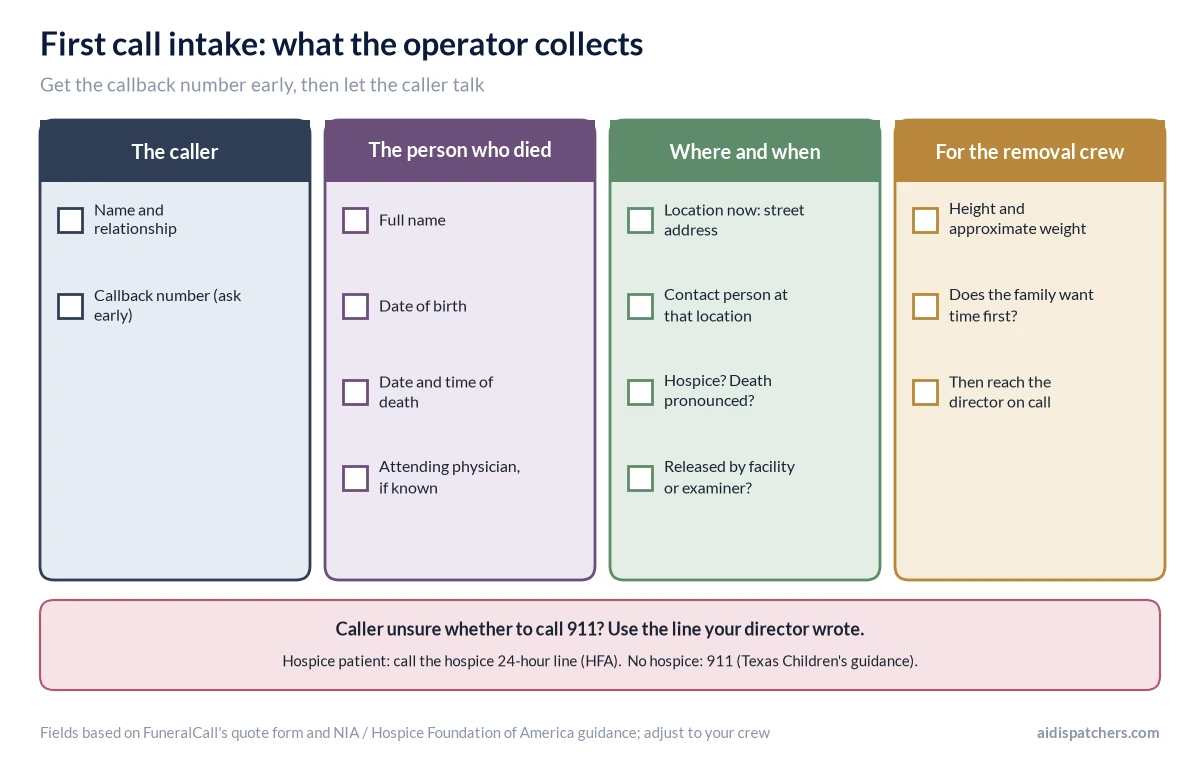
Order matters. Get the callback number early, in case the line drops. Then let the caller talk. People reporting a death often start with what happened, not with the facts on your sheet, and an operator who cuts in with “date of birth?” sounds cold.
Then there’s timing. After a death at home, “there is no need to move the body right away,” the National Institute on Aging tells families. The Hospice Foundation of America says mortuary staff come “when loved ones are ready.” So your script should ask, not assume.
When the family hasn’t called anyone else yet
Sometimes the funeral home is the first number a family dials. They don’t know whether to call 911, and the operator needs a scripted answer your director has approved, not an improvised one.
Hospice cases are the easy ones. The Hospice Foundation of America tells families of hospice patients who die at home not to call 911. They call the hospice’s 24-hour line instead, and someone from the team comes to confirm the death. Without hospice it’s different: bereavement guidance from Texas Children’s Hospital says to start with 911. In both cases a doctor, hospice nurse or other official has to pronounce the death before a death certificate can be prepared, the NIA notes.
That keeps the operator’s job small. Ask about hospice. Read the line your director wrote for that answer. Take the details and get the director on the phone. No medical or legal advice beyond the script.
Price calls and the FTC Funeral Rule
This is the part general answering services tend to get wrong. Under the FTC Funeral Rule, you have to give people who call and ask about prices “accurate information from your General Price List, Casket Price List, and Outer Burial Container Price List.” Using an answering service is fine. The FTC guide says so directly, and adds that the service can take names and numbers so you can “return the calls at your earliest convenience.”
A few details trip people up:
- Callers can stay anonymous. Your operator can ask for a name and number. If the caller says no, they still get the prices, either then or when they ring back. A name or phone number can’t be made a condition.
- No “come in and we’ll talk.” Requiring a visit before quoting prices isn’t allowed.
- After hours can usually wait. If you don’t normally give prices at night, you don’t have to start. There’s one exception. When someone calls after hours about an at-need situation and your home makes arrangements after hours, the FTC says “you should provide price or other information the consumer requests.”
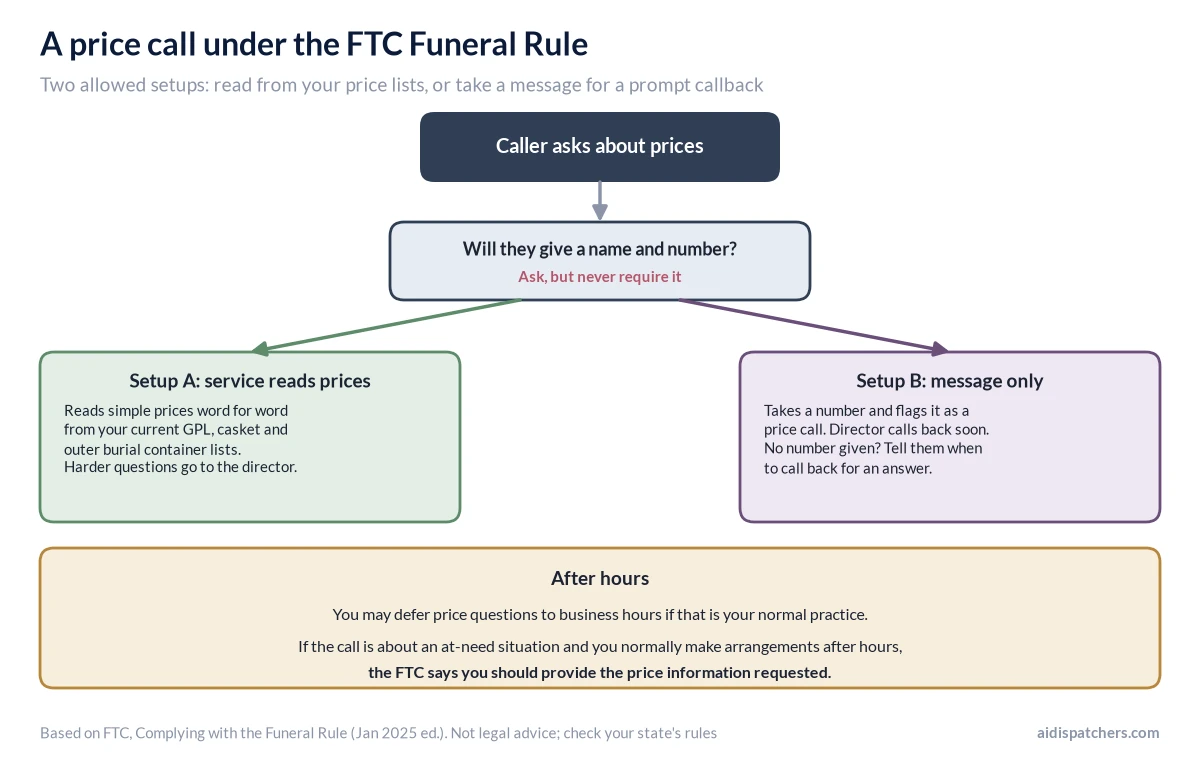
You have two workable setups. In the first, the service never quotes a number. It takes a message, flags it as a price call, and you call back quickly. In the second, you give the service your current price lists and let it read simple prices, like direct cremation, word for word. The FTC guide describes this for employees: someone can handle “easier questions” from the printed lists and pass harder ones to you. If you pick the second setup, send the service a new copy every time your GPL changes. An out-of-date price read to a family is worse than a callback.
Funeral-specialist, general or AI answering service?
There are three kinds of service you’ll run into.
Funeral-only live services. ASD (Answering Service for Directors), FuneralCall and Directors’ Choice specialize in funeral homes and other deathcare businesses. Their operators already know what a first call is, and they sell features built around it. ASD says it has been family-owned since 1972 and has served only funeral homes since the mid-1990s. It also claims “more than a third of all funeral homes in the United States” as clients. None of the three publishes prices. FuneralCall’s pricing page is a quote form that asks about your call volume and first calls per year.
General live services. Ruby, PATLive, Posh, Abby Connect, AnswerConnect and Smith.ai answer for all kinds of businesses and publish their prices. You’ll need to train them on your script, and you should test them harder on death calls, since that’s not their daily work.
AI receptionists. These answer instantly, cost the least at higher volumes, and handle schedule and direction questions well when you give them a current service list. NextPhone markets one to funeral homes specifically. The open question is the death call. A caller who is crying, or who stops mid-sentence, is the hardest test there is for a voice AI. If you go this way, keep the AI’s part short on those calls: get the basics, then transfer to the director on call. And listen to your own test calls before you trust it.
Staffing is also why the question comes up now. Announcing its 2025 Cremation & Burial Report, the National Funeral Directors Association said personnel shortages remain the top business challenge for funeral homes.
What a funeral home answering service costs
Funeral homes don’t get many calls compared with a plumber or a dental office, so the low tiers matter. The table uses two volumes: about 40 calls a month (100 minutes) and about 120 calls (300 minutes). That calls-to-minutes ratio comes from PATLive’s pricing page. First calls run long, so if your nights are mostly death calls, budget for the higher column.
| Service | Type | About 40 calls / 100 min | About 120 calls / 300 min | Notes |
|---|---|---|---|---|
| ASD, FuneralCall, Directors’ Choice | People, funeral only | Quote | Quote | No published prices |
| Smith.ai receptionists | People | $415 | $1,125 | Billed per call: $300 for 30 calls, then $11.50 each; $810 for 90, then $10.50 |
| Abby Connect | People | $329 | About $899 | $599 for 200 minutes, overage at the plan’s minute rate |
| Ruby | People | $395 | $720 + overage | 200-minute plan; overage rate not published, next plan is $1,725 for 500 |
| Posh | People | $215 | $630 | $420 for 200 minutes plus 100 at $2.10 |
| PATLive | People | $189 | $479 | 100- and 300-minute plans |
| AnswerConnect | People | $350 | $395 | Entry plan (200 min) adds a $49.99 setup fee; 300-minute plan has none |
| AI Dispatchers | AI | $299 | $499 | Starter: first 100 minutes. Growth: up to 300 minutes |
| Smith.ai AI Receptionist | AI | $45 | $262.50 | Free plan covers 25 calls, then $3.00 each; Pro is $150 for 75 calls, then $2.50 each |
| NextPhone | AI | $199 | $199 | NextPhone lists unlimited calls on this plan |
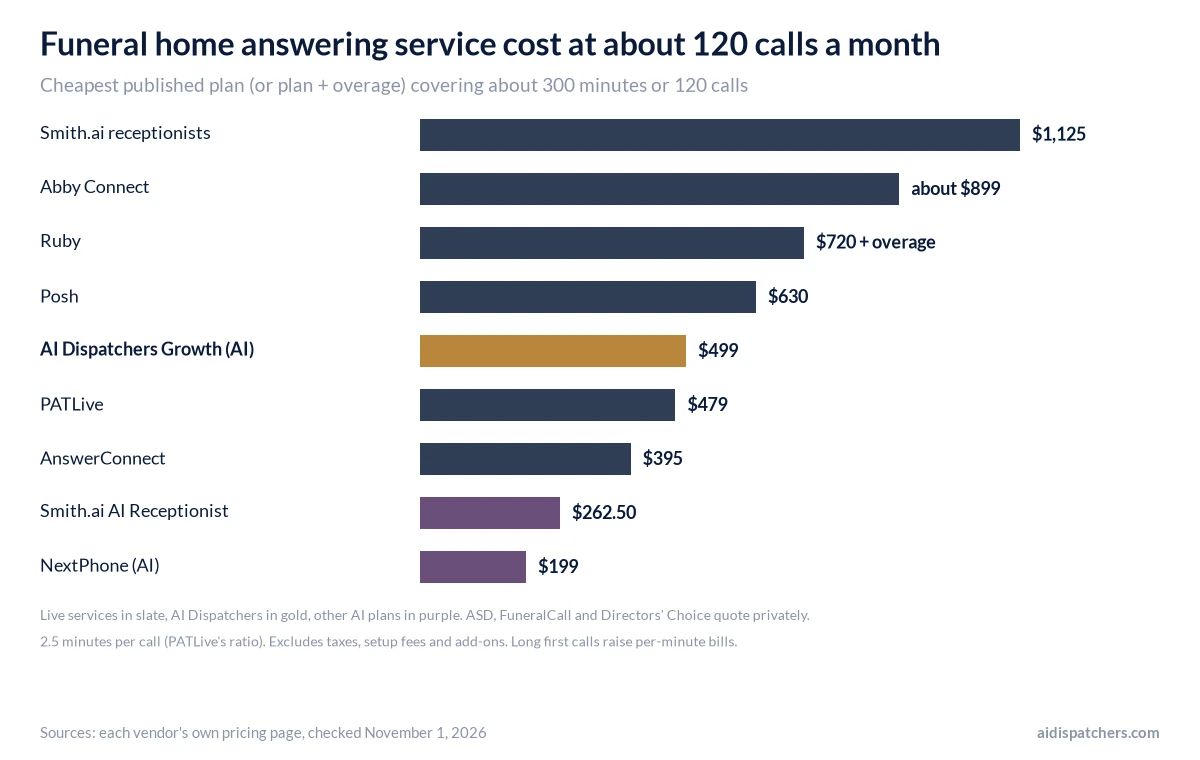
Two things the table can’t show. Per-minute plans charge for the whole call, so a gentle 8-minute first call costs more than a 2-minute directions call. And funeral specialists may well cost more or less than these numbers. Get two quotes before you assume either way. For more on how billing works across these companies, see our answering service cost guide and the guide to outsourced phone answering.
Setting it up: what to give the service
The first week goes better if you hand over everything at once:
- An on-call rotation with a backup number for each night, and how long the operator should wait before trying the backup
- Your first-call script, including the hospice and non-hospice lines from your director
- Current price lists (GPL, casket, outer burial container) if the service will read prices, plus your rule for after-hours price calls
- A daily service sheet: visitations, services, locations, livestream links and the obituary page address
- Frequent callers: the hospices, hospitals and facilities that call you, so the operator recognizes them
- How messages reach you: text for first calls, email for routine ones, and what counts as urgent
If you already send calls to a service after hours, our after-hours answering service guide covers forwarding options and the ways overflow coverage differs from all-night coverage.
Five test calls before you go live
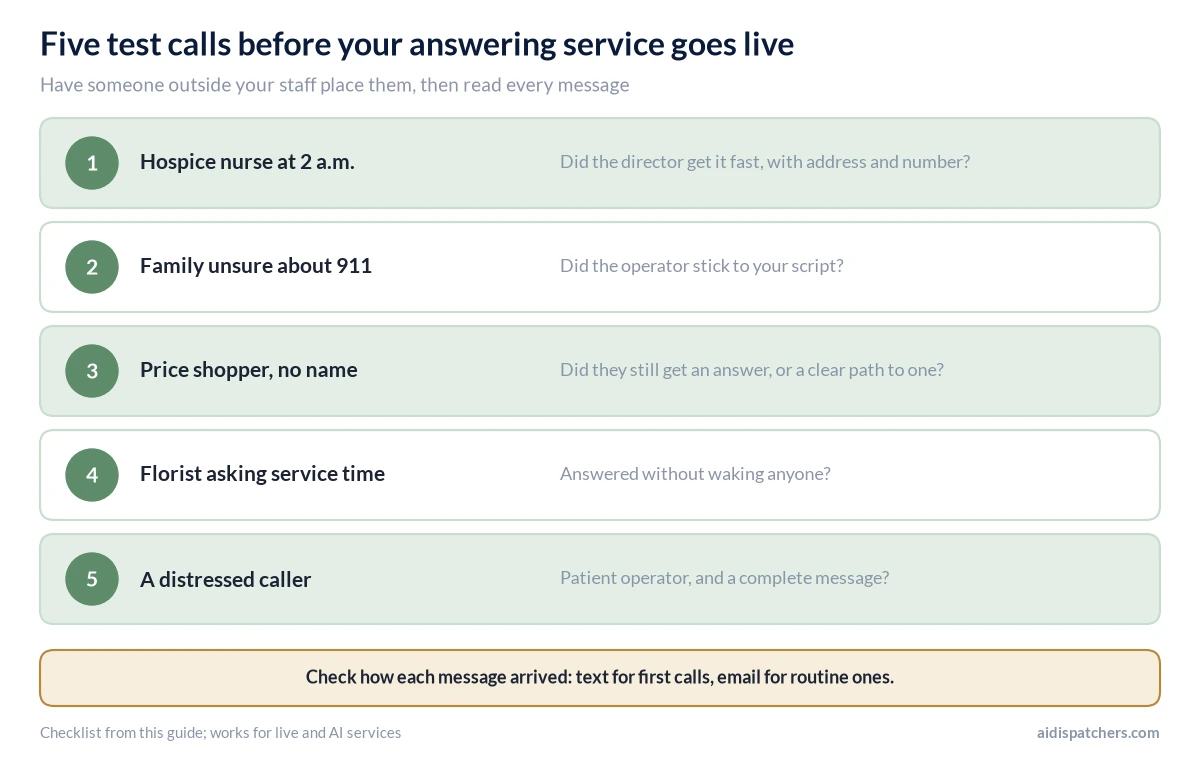
Many of these services offer a free trial or a free plan. Use it. Have someone who isn’t on staff place these calls, then read every message that comes back.
- A hospice nurse at 2 a.m. reporting a death at home. Did the director get it in minutes, with the address and the nurse’s number?
- A son who found his dad at home and doesn’t know if he should dial 911. Did the operator use your script, or wing it?
- Someone asking what direct cremation costs who won’t give a name. Did they get a price, or at least know when to call back for one?
- A florist asking for tomorrow’s service time. Did the operator answer without waking anyone?
- Someone crying too hard to finish a sentence. Did the operator wait it out? Is anything missing from the message?
Where AI Dispatchers fits
AI Dispatchers is the AI receptionist behind this site, and funeral homes aren’t a specialty we advertise. It answers around the clock, notes who called and what they need, books appointments, and sends confirmations by text. Our Starter plan is $299 a month for the first 100 minutes; Growth is $499 for up to 300 minutes and includes emergency and priority escalation along with call transfers, which you’d use to put a first call through to whoever is on call that night. Plans are listed in our pricing section.
We’re not the cheapest. Smith.ai’s AI plan and NextPhone both come in under us in the table. And a funeral-only live service knows first calls on day one, where we’d have to be taught your script. Families who expect a human voice on every death call are better served there. But if your phone is mostly schedules, directions and messages, and what you really need is first calls reaching the director fast, test an AI line. For a broader comparison, read AI receptionist vs human receptionist. If you’d like to hear how it would handle your calls, book a demo or use the form below.
Funeral home answering service FAQ
What is a first call in funeral service?
In funeral homes, the first call is how a death gets reported, and it starts the transfer into the home’s care. Families make it, but so do hospices, hospitals, nursing facilities and medical examiners. If an answering service gets one call type right, it should be this one: straight to the director on call.
What goes on a funeral home first call sheet?
At a minimum: the caller’s name, relationship and callback number; the full name and date of birth of the person who died; the date, time and place of death; and whether the death has been pronounced. Many homes also ask for height and approximate weight for the removal crew, the attending physician, and whether the family wants time before the pickup.
Do funeral homes have to give prices over the phone?
Yes, if the caller asks. The FTC Funeral Rule requires accurate prices over the phone from the General Price List, Casket Price List and Outer Burial Container Price List. Homes can’t demand a name or number first, or tell people to come in. Taking a message for a callback is fine, and price calls can usually wait until business hours.
Who do you call when someone dies at home?
Not always 911. If hospice was caring for the person, the family’s first call goes to the hospice’s 24-hour line, and a nurse comes out to confirm the death, per the Hospice Foundation of America. No hospice? Then 911, according to Texas Children’s Hospital. The funeral home is the call after that.
When should you call the funeral home after a death?
Whenever the family is ready, once someone has pronounced the death. For home deaths, the National Institute on Aging says nothing needs to move right away, and the Hospice Foundation of America says mortuary staff can come at the family’s pace. Ask the family. Don’t hurry them.
How much does a funeral home answering service cost?
Funeral-only services such as ASD, FuneralCall and Directors’ Choice quote prices privately. Among general services with published prices on November 1, 2026, about 40 calls a month ran from $189 to $415 for live receptionists, and about 120 calls ran from $395 to $1,125. AI receptionists ran from $45 to $499 across both volumes.
Can an AI answering service handle funeral home calls?
It can handle service times, directions, obituary questions and messages well when it has your current schedule. Death calls are harder: callers may be crying or confused. If you use AI, have it collect the basics and transfer first calls to the director on call right away, and test it with realistic calls before going live.
Do funeral homes answer the phone 24 hours a day?
Deaths get reported at all hours, so homes generally have a director on call overnight, or a service that can reach one. Arrangement meetings and price questions often wait for daytime. For price calls the FTC allows that when it’s your normal practice. The exception: an at-need caller, at a home that makes arrangements after hours.
Talk to us about your calls
Tell us a little about your business and a specialist will get back to you. Fields marked * are required.