
An outsourced phone answering service is an outside company that picks up your business calls for you, under your business name. You forward your line to them, they follow the instructions you give them, and you get a message, a transferred call or a booked appointment at the other end. The people (or the AI) answering never work in your office.
The price range is wider than most owners expect. At roughly 100 calls a month, the published plans we checked came to about $70 for the cheapest AI option and $915 for the priciest live-agent one. Which end you land on depends less on the vendor than on how much of the phone you hand over, and how well you hand it over. That’s what most of this guide is about.
Vendor prices and terms last checked October 29, 2026, on each company’s own pricing or FAQ page. Wage data from the U.S. Bureau of Labor Statistics.
What an outsourced phone answering service actually does
At the simple end, an agent answers with your greeting, writes down who called and why, and sends that to you. That’s message taking, and on its own it isn’t much better than voicemail. The more useful services also:
- put the call through to you or a colleague if you’re free, or promise a callback if you aren’t
- book appointments into your calendar
- answer the questions you get every day, like hours, service area and rough prices
- screen out sales pitches and robocalls
- wake up the on-call person when a caller has a real emergency
Whatever a vendor calls itself, check which of those jobs your plan covers. Smith.ai, for one, adds $1.50 for each appointment it books, and $15 a month for every extra transfer number. Ruby’s FAQ page goes as far as saying a plain answering service often does “only the simplest tasks.”
Three ways to outsource your phone line
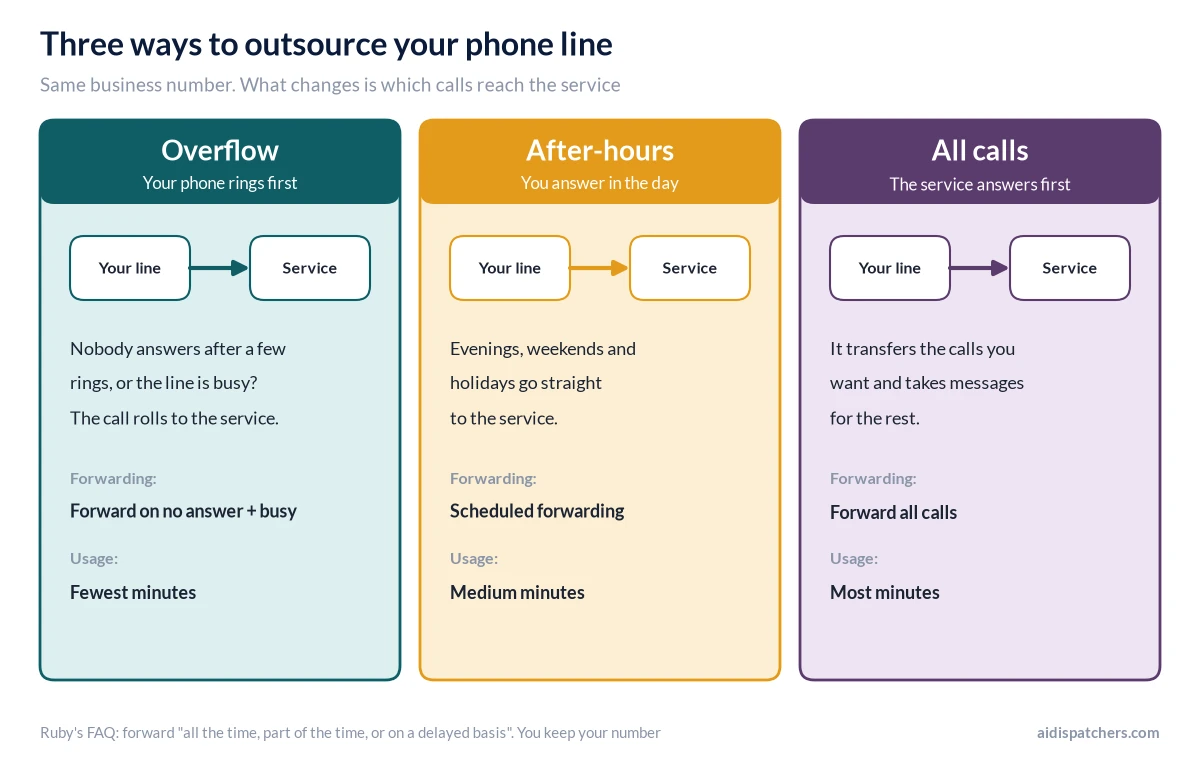
Nobody says you have to hand over every call on day one. We see three common setups. The difference between them is mostly which forwarding setting you turn on with your carrier or phone system.
| Setup | What happens | Forwarding you’d use | Good fit for |
|---|---|---|---|
| Overflow | Your phone rings first. If nobody picks up after a few rings, or the line is busy, the call rolls to the service. | Forward on no answer and on busy | Small teams who answer most calls but miss them on jobs or at lunch |
| After-hours | You answer during the day. Evenings, weekends and holidays go straight to the service. | Scheduled forwarding, or switching it on when you lock up | Trades and offices where night calls are often urgent |
| All calls | Every call goes to the service, which transfers the ones you want to take. | Forward all calls | Solo owners who can’t stop work to pick up |
Ruby’s FAQ sums it up in one line. You can forward your number “all the time, part of the time, or on a delayed basis.” On most lines that’s a code you dial from the office phone, and the vendor’s onboarding team can talk you through it. Your number stays yours.
Not sure? Start with overflow. Someone on r/smallbusiness gave good advice on this in August 2026. Open “an overflow lane” for the repetitive stuff first. Keep new bookings and upset customers in-house until the handoff has proven itself, and check a sample of calls each week. It costs less, and you learn what the service gets wrong while the stakes are low.
Live agents or AI: who picks up?
“Outsourced” used to mean a room full of people in a call center. In 2026 it can also mean an AI voice agent, or a mix of the two. The differences that matter in practice:
- Live agents handle odd requests and upset callers better, and some callers simply want a person. They’re paid by the minute or by the call, so a busy month costs more.
- AI agents answer on the first ring at any hour, often for a tenth of the price. They’re only as good as the instructions and information you load, and some callers will ask for a human straight away.
- Hybrid plans send some calls to people and some to AI. On Abby’s plans, an AI minute uses up half as much of your allowance as a human one.
We compare these side by side in AI receptionist vs answering service vs voicemail. If you’re choosing between outsourcing and hiring, our AI receptionist vs human receptionist cost breakdown runs those numbers.
If it matters to you, check where the people are. PATLive, Ruby, Abby and Moneypenny’s U.S. service all say on their own sites that their receptionists are U.S.-based. Smith.ai’s pricing page says “no overseas agents.” Larger call-center outsourcers often answer from several countries; Fusion CX, for one, lists 40+ locations in 13 countries. Neither is wrong, but you should know which you’re buying.
How much does an outsourced phone answering service cost?
Live services bill by the minute or by the call, and AI services by the minute, by the call or as a flat plan with an allowance. To compare them fairly we used two sizes of account and the cheapest published plan (or plan plus overage) that covers each. We assumed 2.5 minutes per call, from PATLive’s own note that 100 minutes is “about 40 calls.”
| Service (who answers) | About 40 calls (100 min) | About 100 calls (250 min) | Billing notes from its own site |
|---|---|---|---|
| PATLive (people) | $189 | $448.50 | Per minute; no charge for after-call notes or wrap-up; no contracts; “plus government taxes and fees” |
| Posh (people) | $215 | $525 | Per minute; prices effective 1/1/26 |
| AnswerConnect (people) | $350 ($399.99 first month) | $395 | Per minute, rounded up per interaction; $49.99 setup on some plans; first 30 interactions under 30 seconds free each cycle |
| Ruby (people) | $395 | Not computable | Per minute, 60-second rounding; after-call work counts; overage rate not printed on the pricing page |
| Smith.ai receptionists (people) | $415 | $915 | Per call; spam isn’t counted if your line passes caller ID; booking is a $1.50 add-on per call |
| AI Dispatchers (AI) | $299 | $499 | Flat plan with minutes; setup and onboarding included |
| Smith.ai AI receptionist (AI) | $45 | $212.50 | Per call; free tier of 25 calls |
| Dialzara (AI) | $48.20 | $112.50 | Per minute; overage $0.35 to $0.48 |
| Upfirst (AI) | $39.95 | $69.95 | Per call; overage $0.70 to $1.50 depending on plan |
Pricing pages: PATLive, Posh, AnswerConnect, Ruby, Smith.ai receptionists, Smith.ai AI, Dialzara, Upfirst. AI Dispatchers prices are from our pricing section.
A few notes on the math. Ruby’s 200-minute plan is $720, but because Ruby doesn’t publish its overage rate, we can’t price 250 minutes without guessing. AnswerConnect’s $350 Entry plan covers the smaller account, and its $395 Growth plan (300 minutes, no setup fee) covers the larger one. Per-call services come out ahead when calls run long, and per-minute services when calls are short.
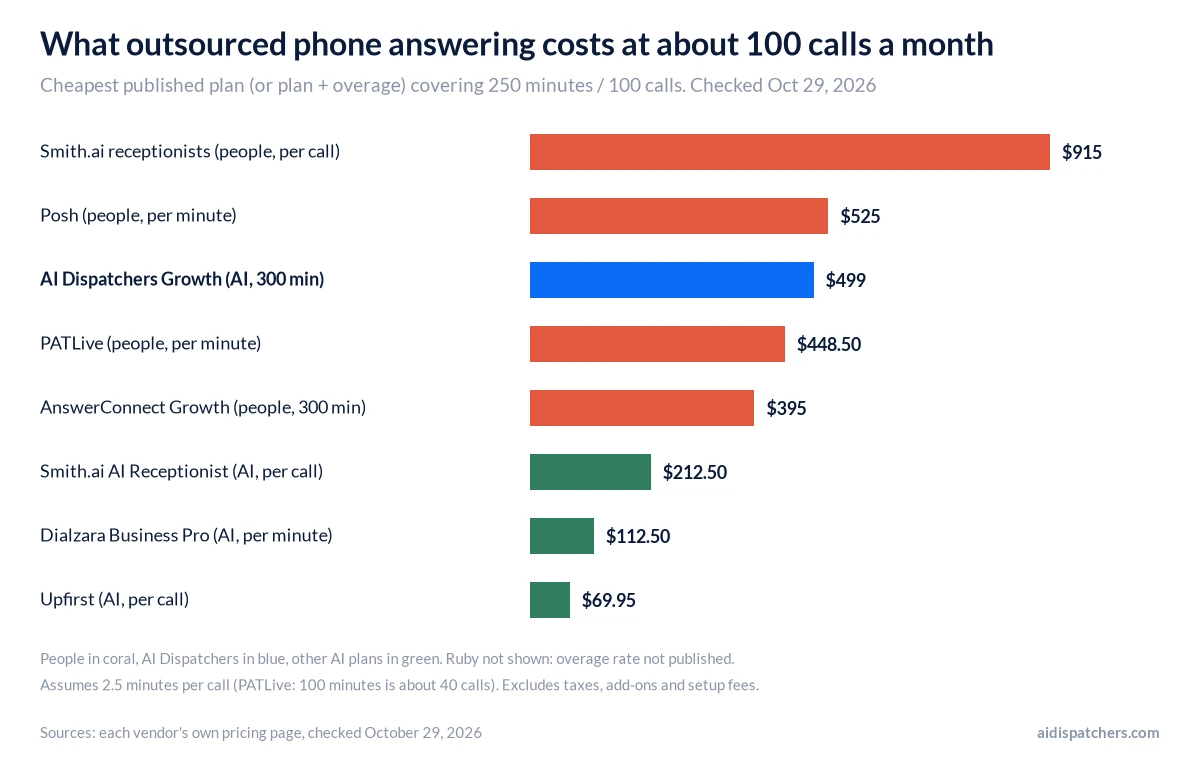
Billing rules can move these numbers more than the sticker price. Ruby bills in 60-second increments, rounded up, so a 10-second call is billed as 60 seconds. Time the agent spends finishing your message after the caller hangs up counts too. PATLive says it doesn’t bill for that wrap-up time at all. AnswerConnect rounds up each interaction to the nearest minute but doesn’t charge for the first 30 interactions under 30 seconds in a billing cycle. Two services with the same per-minute rate can send you quite different bills.
For comparison, a full-time receptionist at the BLS median of $18.27 an hour earns about $3,167 a month before benefits. That buys 40 of the 168 hours in a week. Our answering service cost guide and virtual receptionist cost breakdown go deeper on plan tiers.
The handover kit: what to send before you go live
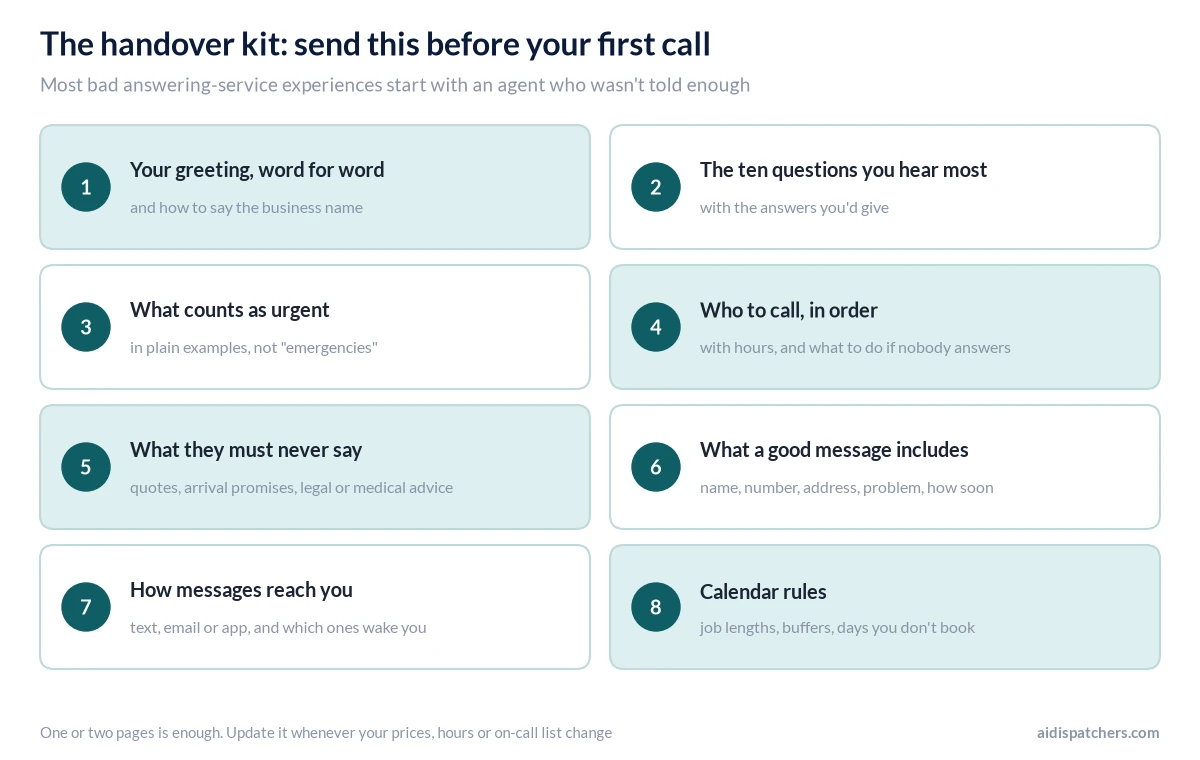
Read enough complaints about answering services and the same story keeps coming up. The agent didn’t know enough to help. The caller got a polite “I’ll pass that on,” and the owner got a message that said almost nothing. You fix that before the first call, not after. Put the following on a page or two and send it to whoever will be answering:
- Your greeting, word for word, and how you’d like your business name said.
- The ten questions you hear most, with the answer you’d give. Hours, service area, whether you do free estimates, how soon you can come out.
- What counts as urgent for your business, in plain examples. “Water coming through the ceiling” is clearer than “emergencies.”
- Who to call for urgent calls, in order, with the times each person can be reached, and what to do if nobody answers.
- What they must never say. Prices you don’t quote over the phone, promises about arrival times, anything legal or medical.
- What a good message looks like. Ours would be: name, callback number, address (if you go to them), the problem in the caller’s own words, how soon they need you.
- Delivery: text, email or the vendor’s app, plus which messages are worth waking you for.
- Calendar rules, if they’ll be booking for you. How long jobs take, gaps between them, days you don’t book.
Your first 30 days with a new service
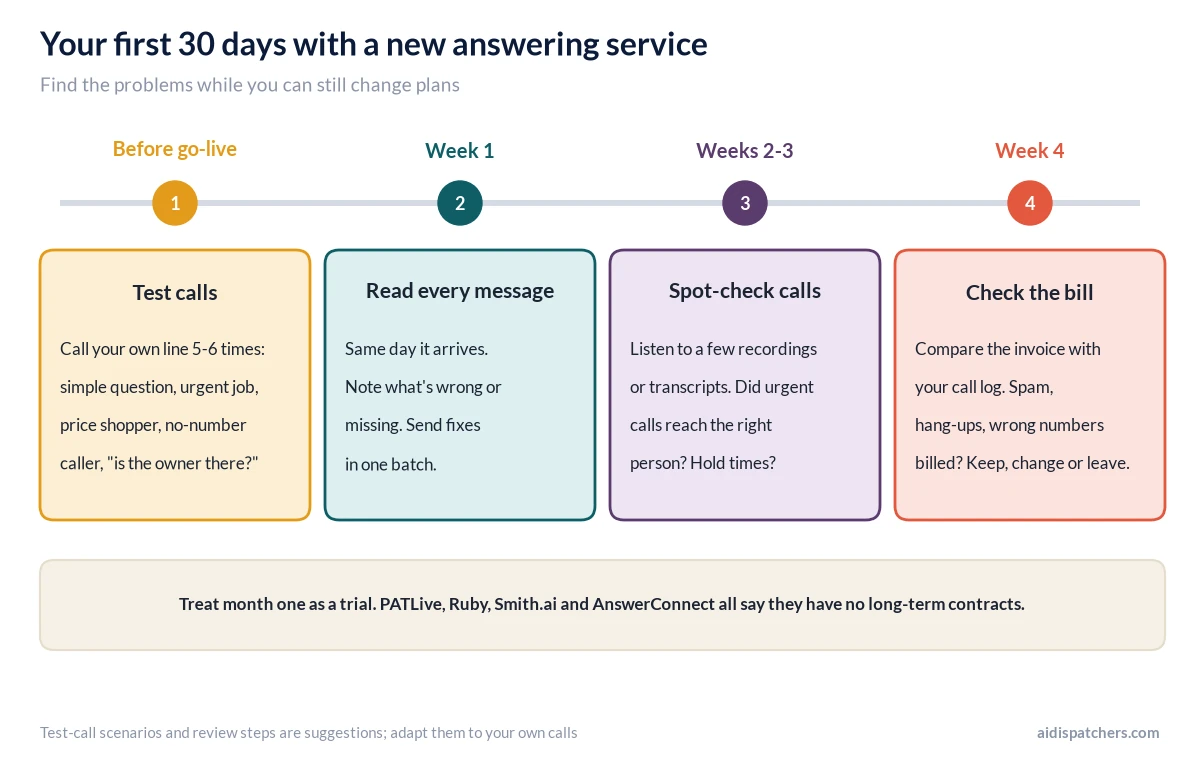
Treat the first month as a trial, whatever the contract says. A rough plan:
- Before go-live: ring your own number five or six times and play a different customer each time. One wants your hours. One has water on the floor. One just wants a price. Then try a caller who won’t leave a number, and one who insists on talking to you.
- Week 1: read every message the day it arrives. Note anything wrong or missing and send corrections in one batch.
- Weeks 2 and 3: if there are recordings or transcripts, pull a few each week. Did anyone wait too long? Did the urgent ones get to the right phone?
- Week 4: compare the invoice with your own call log. Look for billed minutes on spam, wrong numbers and hang-ups, then decide whether to keep the plan, change it or move on.
Questions to ask before you sign
Most of these answers are on the vendor’s pricing or FAQ page if you look. If they’re not, ask in writing:
- Do you bill per minute or per call? If per minute, how do you round, and does after-call work count?
- Do spam calls, wrong numbers and hang-ups count toward my plan?
- What’s the overage rate on my plan, and will you warn me before I hit it? (Ruby, for instance, sends app alerts at 85% and 100% of your minutes.)
- Is there a setup fee, and is there a contract or notice period to cancel?
- Which features cost extra: booking, transfers, extra transfer numbers, Spanish, call recording?
- Do nights, weekends and holidays cost more?
- Where are the people answering my calls, and do you ever send calls to partner companies?
- If I leave, can I take the phone number you gave me?
Answers vary a lot. PATLive says it charges no night or weekend fees and uses no contracts. Smith.ai is month to month with a 30-day money-back guarantee on new plans, capped at $1,000 and excluding overage. Ruby says you’re free to take the number it assigns you when you leave.
When outsourcing isn’t worth it
Not every business needs one. Say you get a few calls a week and can ring people back within the hour. A clear voicemail greeting and a quick callback may serve them better than a stranger reading a script. The same goes for businesses where nearly every call is a detailed quote that only you can give.
Some owners also object on principle. One commenter in r/smallbusiness said they’d never want a customer’s first impression of their business to come from someone with only “a cursory understanding” of it. That’s a fair worry, and it’s the reason the handover kit above matters so much. If you can’t give the service enough to do the job well, the money’s better spent on a part-time hire or on your own callback routine.
It pays off on the calls you’d have lost anyway. Think of the after-hours emergency, or the lead who rings while you’re up a ladder and then tries the next company on the list. If you’re not sure how many of those you get, our piece on the real cost of missed calls walks through how to estimate it.
Where AI Dispatchers fits
We sell an AI voice agent, not live receptionists, so read this with that in mind. Starter is $299 a month for the first 100 minutes and includes booking with SMS confirmations. Growth is $499 for up to 300 minutes and adds emergency escalation and smart routing and transfers, which is what you’d want for after-hours or all-call setups. Every plan includes setup and onboarding. As the table shows, several AI services cost less than we do at these volumes. And if you want a person on every call, go with a live service. If you’d like to hear how an AI agent would handle your calls, book a demo or use the form below.
Questions people ask about outsourced phone answering
How does an answering service work?
You forward your business number to the service, either all the time, when nobody picks up, or after hours. An agent or AI answers with your greeting, follows the instructions you gave them, and then takes a message, transfers the call or books an appointment. The details reach you by text or email, often right after the call ends.
What is the point of an answering service?
It catches the calls you’d otherwise miss: while you’re on a job, with a customer, closed for the night or already on another line. Callers reach someone who can help or at least take a proper message, instead of a voicemail they may not bother to leave. It’s most useful when a missed call can mean a lost job.
How much does an outsourced phone answering service cost?
On published plans we checked on October 29, 2026, about 40 calls a month cost $189 to $415 with live agents. The cheapest AI plans came to roughly $40 to $50. At about 100 calls a month, live plans ran $395 to $915 and AI plans $69.95 to $499. Setup fees and add-ons can change the real bill, and so can the way a service rounds minutes.
Do people still use answering services?
Yes. Live-agent companies like PATLive, Ruby and Smith.ai still publish plans for small businesses, and many now sell AI answering alongside or instead of people. What’s changed is the choice. You can now have people answer, or AI, or split calls between them.
How does an AI answering service work?
An AI voice agent answers your forwarded calls, understands what the caller says and replies out loud using the business details and rules you set up. It can answer common questions, take messages, book into a calendar and transfer urgent calls to a person, depending on the plan. It won’t know anything you haven’t told it, so the setup matters.
Are outsourced phone answering services available 24/7?
Most are. The live services we priced all advertise around-the-clock answering, and AI services answer at any hour by design. Check whether nights, weekends or holidays cost extra. Also ask whether add-ons such as Spanish-language answering are available at every hour, or only in the daytime.
Are outsourced answering services based overseas?
Some are and some aren’t. PATLive, Ruby, Abby and Moneypenny’s U.S. service say their receptionists are U.S.-based, and Smith.ai says it uses no overseas agents, while large call-center firms often answer from several countries. If it matters to you, ask where agents sit and whether calls are ever passed to partner companies.
Can I keep my phone number if I outsource my calls?
Yes. With most services you simply forward your existing number, so customers keep calling the same line. Some, like Ruby and Smith.ai, can also port your number or give you a new local or toll-free one. If they do, confirm you can take it with you when you leave.
Talk to us about your calls
Tell us a little about your business and a specialist will get back to you. Fields marked * are required.