
Based on the published price lists we checked, most small businesses would pay somewhere between about $50 and $1,000 a month for an answering service, depending on call volume and what you need done on each call. Live, human services generally bill per minute (roughly $1.10 to $1.55 a minute on published plans) or per call (around $7 to $12). AI receptionists usually bill a flat monthly fee for a bucket of minutes, callers or calls, with entry plans from about $29 to $299. Hiring a full-time receptionist costs far more than either.
The rest of this guide shows where those numbers come from, works out real monthly bills, and explains the fees that catch people out. All competitor prices below were read from each company’s own pricing page on October 17, 2026. Prices change, so check before you buy.
What pricing models do answering services use?
There are four, and the model matters as much as the sticker price.
Per minute. You pay for talk time, usually with a monthly bucket and an overage rate. Good when calls are short. Painful when they run long.
Per call. You pay per answered call regardless of length. Good for long calls like legal intake. Expensive if you get lots of 30-second “are you open Saturday?” calls.
Per unique caller. Goodcall charges by the number of different people its AI helps in a month, so one customer who calls five times counts once.
Flat monthly. Most AI receptionists, including ours, sell a monthly plan with a set number of minutes. A few advertise unlimited calls.
What do live answering services cost?
Two published examples, one per minute and one per call.
Specialty Answering Service (per minute): Economy is $44 a month plus $1.54 a minute. Bundles run from $159 for 100 minutes ($1.44 per extra minute) and $269 for 220 minutes ($1.44 extra) up to $649 for 500 minutes ($1.34 extra), with larger plans beyond that. It bills by the second, and its pricing page lists a free trial of two weeks or 200 minutes with no credit card.
Smith.ai receptionists (per call, human-first): $300 a month for 30 calls, $810 for 90 calls and $2,100 for 300 calls, with overage of $11.50, $10.50 and $8.50 a call. Some features cost extra per call: appointment booking is $1.50, text and email follow-up $0.50, call recording and transcription $0.25. All plans come with a 30-day money-back guarantee per its page.
Ruby, another well-known live service, sells plans by receptionist minutes (50, 100, 200, 500 and up), but its prices didn’t display when we checked, so you’ll need to ask its sales team.
What do AI receptionists cost?
Entry prices are lower, and the differences hide in what each tier includes.
| Service | Pricing model | Published plans (monthly) | Worth knowing |
|---|---|---|---|
| Dialzara | Minutes | $29 (60 min), $99 (220), $199 (500), $349 (1,000) | Overage $0.35 to $0.48/min; calendar sync starts on the $99 plan; 7-day trial |
| Rosie | Minutes | $49 (250 min), $149 (1,000), $299 (2,000) | Booking directly on your calendar starts at $149; 7-day trial |
| Goodcall | Unique callers | $79 (100 customers), $129 (500), $299 (2,000) | Extra customers 15¢ to 79¢ each; free demo agent instead of a trial |
| NextPhone | Flat (advertises unlimited calls) | $199 (you set it up), $299 (they set it up), $599 | 7-day trial |
| AI Dispatchers | Minutes | $299 (100 min), $499 (300 min), Enterprise custom | Setup and onboarding support on every plan; 14-day free trial |
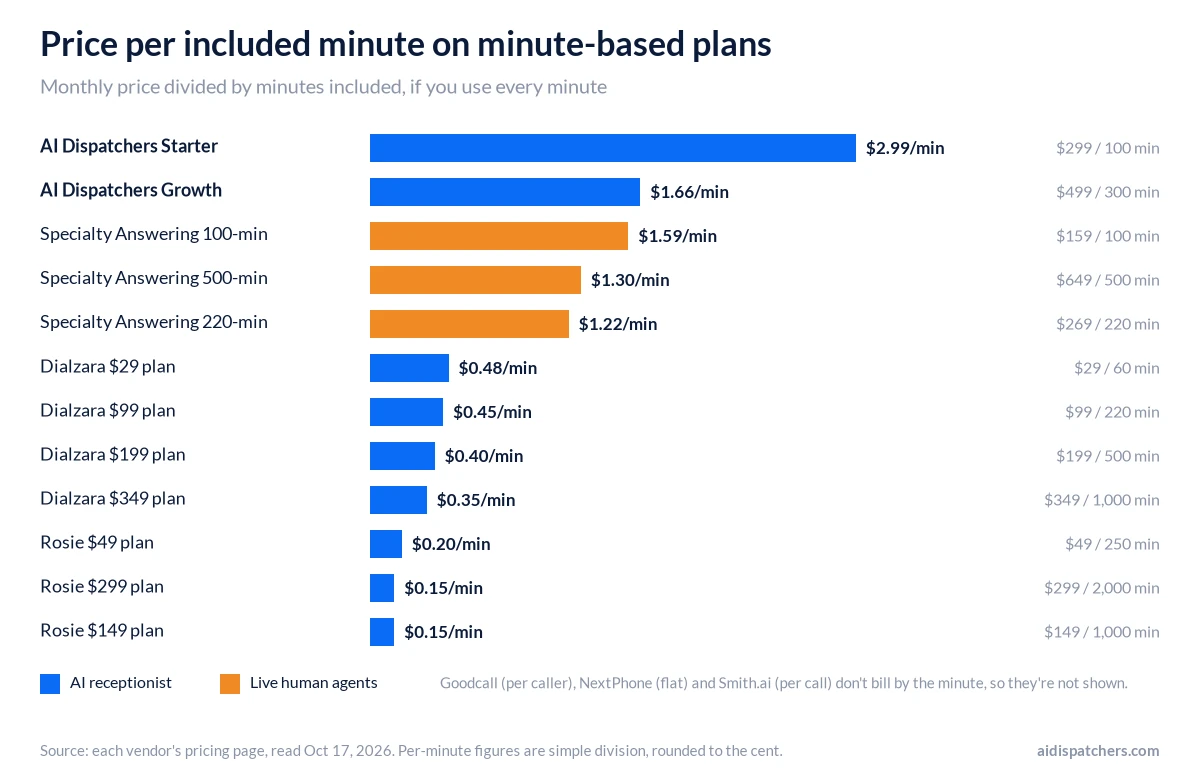
We have the highest entry price in that table. Among the minute-based plans, we’re also the priciest per minute: at $299 for 100 minutes, Starter works out to about $2.99 a minute, and Growth ($499 for 300 minutes) to about $1.66. We’d rather say that plainly than have you find it on a spreadsheet later. What you get for it is covered below, and it won’t be the right trade for everyone.
What does a hired receptionist cost?
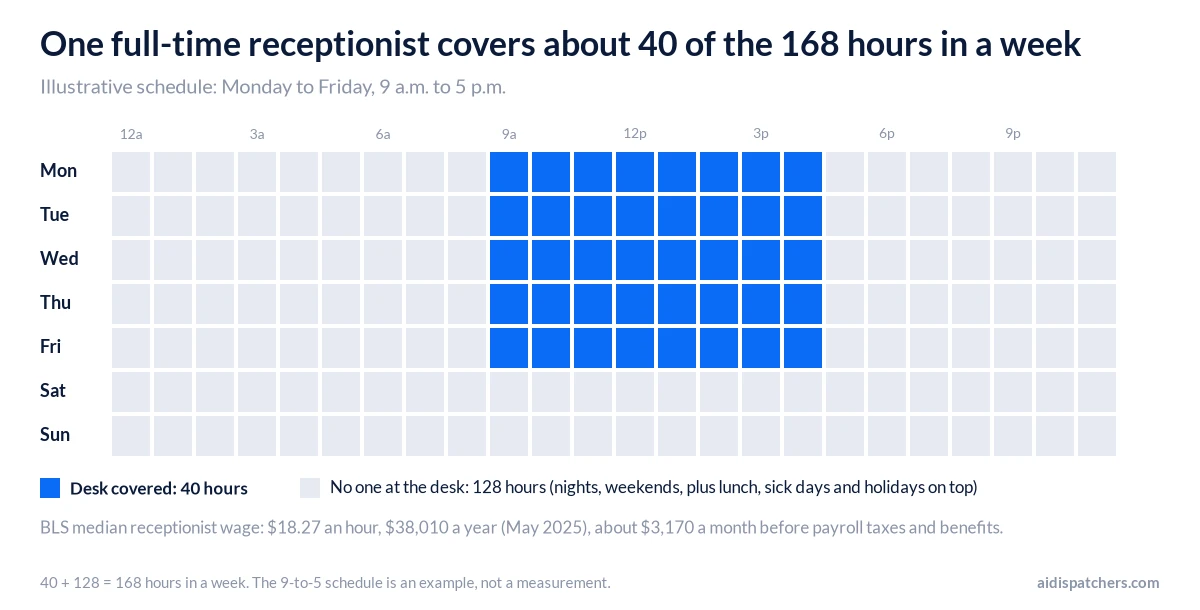
The U.S. Bureau of Labor Statistics puts the median receptionist wage at $18.27 an hour, or $38,010 a year (May 2025 data). That’s about $3,170 a month in wages alone, before payroll taxes, benefits, paid time off and the cost of covering lunch breaks, sick days, nights and weekends. One person covers roughly 40 of the 168 hours in a week.
A receptionist does a lot more than answer phones, so this isn’t a like-for-like swap. But if the phone is the main reason you’re thinking about hiring, the gap is large.
What would 30 or 100 calls a month actually cost?
Here’s the same business priced on each published plan. Assumptions: calls average 3 minutes (check yours), you want appointments booked, and you pick the cheapest plan that covers the volume. Taxes, number fees and other add-ons aside.
| Option | About 30 calls (90 min) | About 100 calls (300 min) |
|---|---|---|
| Specialty Answering Service | $159 (100-min plan) | about $384 ($269 for the 220-min plan + 80 extra min at $1.44) |
| Smith.ai receptionists | $300 + $45 booking add-on | about $915 (90-call plan + 10 overage) + $150 booking add-on |
| Dialzara | $99 (Pro, for calendar sync) | about $135 (Pro + 80 min overage) |
| Rosie | $149 (Scale, for booking) | $149 |
| Goodcall | $79 | $79 (100 calls can’t exceed the 100-customer allowance) |
| NextPhone | $199 | $199 |
| AI Dispatchers | $299 (Starter) | $499 (Growth) |
| Full-time receptionist (median wage) | about $3,170 + overhead | about $3,170 + overhead |
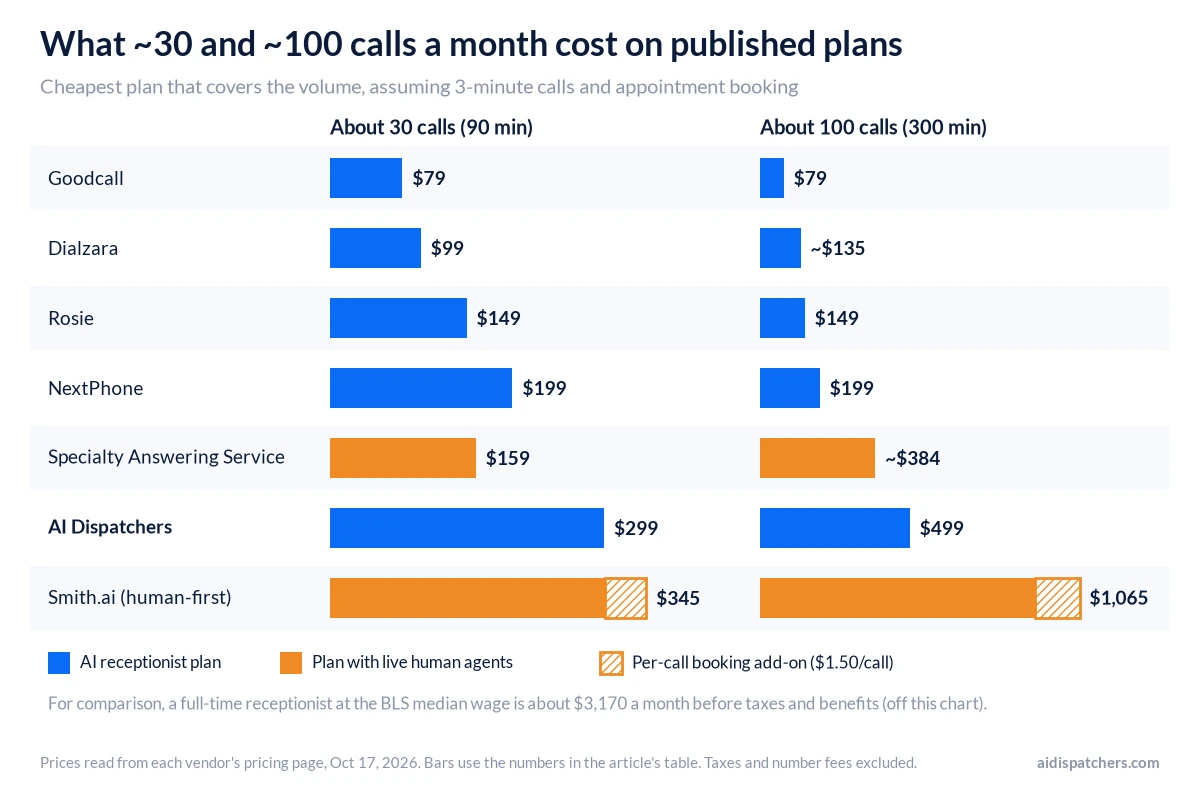
A few honest notes. The live services and Smith.ai put a human on the line, which some businesses need. The AI plans differ a lot in setup help, routing and integrations, so cheapest isn’t automatically best value. And your call length changes everything: at 6-minute calls, per-minute plans double in cost while per-call and per-caller plans don’t move.
What hidden costs should you watch for?
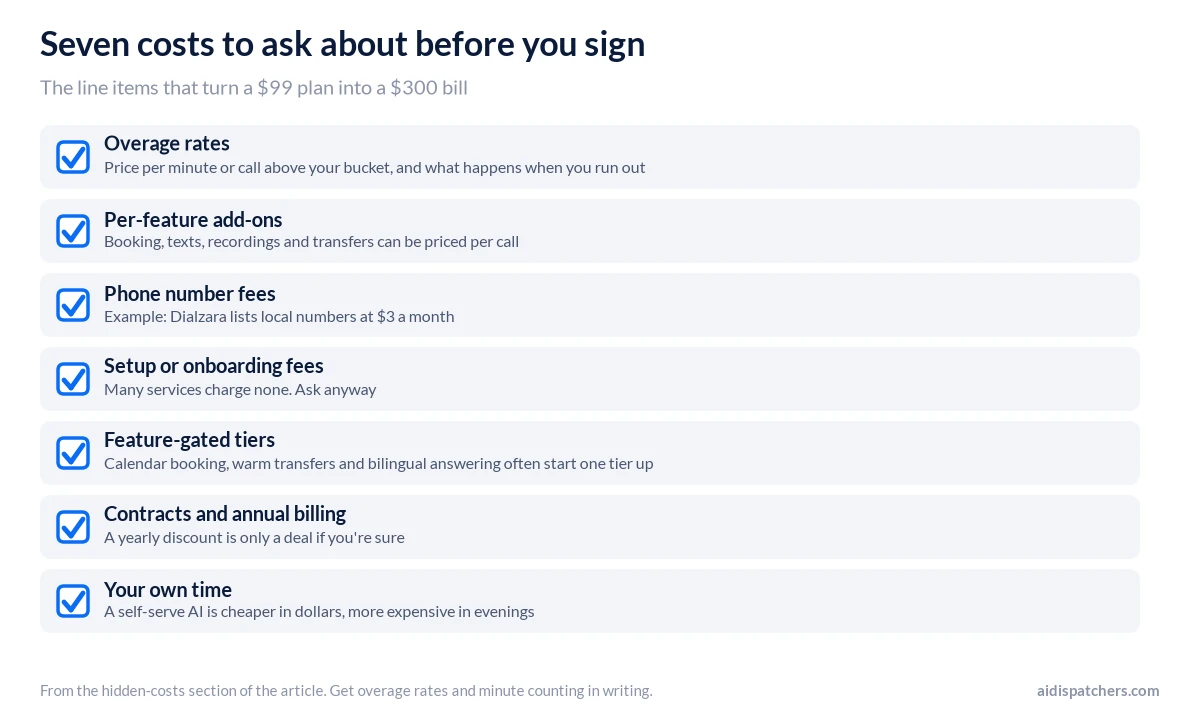
These are the line items that turn a $99 plan into a $300 bill:
- Overage rates. Know the per-minute or per-call price above your bucket, and what happens when you run out.
- Per-feature add-ons. Booking, texts, recordings and transfers are sometimes priced per call.
- Phone number fees. Dialzara, for example, lists local numbers at $3 a month.
- Setup or onboarding fees. Many services charge none; ask anyway.
- Feature-gated tiers. Calendar booking, warm transfers and bilingual answering often start one tier up.
- Contracts and annual billing. A discount for paying yearly is only a deal if you’re sure.
- Your own time. A self-serve AI that you build and tune yourself is cheaper in dollars and more expensive in evenings.
Whoever you pick, ask for the overage rate and how minutes are counted in writing before you start. We’d say the same about our own plans: if you expect to run past the minutes included, contact us first so you know the numbers.
What do AI Dispatchers’ $299 and $499 plans include?
Here’s what’s listed on our plans and pricing.
Starter, $299/month: 100 minutes of AI calls, AI booking and scheduling, SMS confirmations and reminders, 1 calendar integration, call transcripts and logs, and email and chat support.
Growth, $499/month: 300 minutes, everything in Starter, plus emergency and priority escalation, smart routing and transfers, upsell and follow-up automation, two-way SMS, a live dashboard and analytics, 3 integrations, and priority phone support.
Enterprise, custom: for multi-location businesses, with custom voice and scripts, a dedicated account manager, custom reporting and an SLA.
Every plan includes setup and onboarding support: we help configure the AI with your services, prices, hours and scheduling rules rather than handing you a blank builder.
So who should pay that, and who shouldn’t?
Our plans make the most sense if you run a service business where a booked appointment is worth real money, you want help getting the AI set up, and you care about urgent calls getting to a person (Growth). Say you run an HVAC or plumbing company and lose a $400 repair every time a 9 p.m. call goes to voicemail: you don’t need many saved calls to cover $499. See how that looks for HVAC and law firms, or browse home services.
They make less sense if you just need messages taken, get very few calls, or want to build and tweak the agent yourself. In those cases, a lower-cost AI plan or a small per-minute live plan from the tables above may be a better buy. We’d rather you pick the right tool than leave ours in month two.
If you’re unsure, work out what your missed calls cost first. That number tells you what any answering service is worth to you. And if you’re still deciding between types of service, read AI receptionist vs answering service vs voicemail or our guide to the best AI receptionist.
Use the trial to find your real minutes
The 14-day free trial is a clean way to find your real numbers: put your after-hours or overflow calls through AI Dispatchers, then look at the call log. You’ll see your actual call count, average length and which plan fits. Per our terms, a free trial converts to a paid plan unless you cancel before it ends, so put the end date in your calendar. Start your 14-day free trial.
Frequently asked questions
How much does an answering service cost per month?
Most small businesses land between roughly $50 and $1,000 a month on the published plans we checked, and where you fall depends mostly on call volume. Live services bill about $1.10 to $1.55 a minute or $7 to $12 a call, while AI receptionist plans start around $29 to $299 a month. Run last month’s call count and average call length through each price list before you compare.
How much does an AI receptionist cost?
Published entry plans we checked run from $29 a month for Dialzara (60 minutes) to $299 for AI Dispatchers (100 minutes, with setup support). Plans that include calendar booking tend to cost more: Dialzara’s calendar sync starts at $99 and Rosie’s booking starts at $149. Check the overage rate too, because a cheap bucket of minutes gets expensive once you go past it.
What is the cheapest AI phone answering service?
Among the plans in this guide, Dialzara’s $29 plan (60 minutes) has the lowest entry price, followed by Rosie at $49 for 250 minutes and Goodcall at $79 for 100 customers. The catch is what’s left out: booking on your calendar and warm transfers are often reserved for the next tier up, so price the plan that includes what you actually need. We only checked the vendors listed here, not every service on the market.
Is there a free answering service?
Not for ongoing use, in the services we looked at, but several let you try before you pay. Specialty Answering Service advertises a free trial of two weeks or 200 minutes with no credit card, per its pricing page, and Goodcall has a free demo agent. Rosie, Dialzara and NextPhone list 7-day trials. Read the terms on any trial so you know what happens when it ends.
Is an answering service worth it?
It’s worth it when a missed call costs you more than the plan does. Say a 9 p.m. call that goes to voicemail loses a $400 repair: one saved job covers a $299 plan in revenue terms, though you should count your margin, not just revenue. If you get only a few calls a week and mostly need messages taken, voicemail or a small per-minute plan may be the better buy.
Is per-minute or per-call answering service pricing cheaper?
Per-minute is usually cheaper when calls are short, and per-call is usually cheaper when they run long, like legal intake. At $1.44 a minute, a 3-minute call costs about $4.32 and a 6-minute call about $8.64, while Smith.ai’s per-call overage runs $8.50 to $11.50. Divide last month’s total call minutes by your number of calls to see which side you’re on.
What hidden fees should I look for in an answering service?
The usual ones are overage rates, per-feature add-ons, phone number fees, setup fees, features locked to higher tiers and annual contracts. Smith.ai, for example, charges $1.50 per call to book appointments and $0.25 per call for recording and transcription, and Dialzara lists local numbers at $3 a month. Ask for the overage rate and how minutes are counted in writing before you sign up.
Is an answering service cheaper than hiring a receptionist?
For phone coverage alone, yes, by a wide margin. The BLS median receptionist wage is $18.27 an hour, about $3,170 a month before payroll taxes and benefits, and one person covers only about 40 of the 168 hours in a week. A receptionist also does work an answering service doesn’t, like greeting visitors, so it isn’t a like-for-like swap.
Talk to us about your calls
Tell us a little about your business and a specialist will get back to you. Fields marked * are required.