
The AI receptionist vs human receptionist question comes down to one trade. A person brings judgment, warmth and a face at the front desk, for the hours they’re on the clock. An AI picks up at any hour for a small fraction of the cost, and it’s only as good as the rules you give it. Plenty of small businesses use both, so the useful question is which calls go to which.
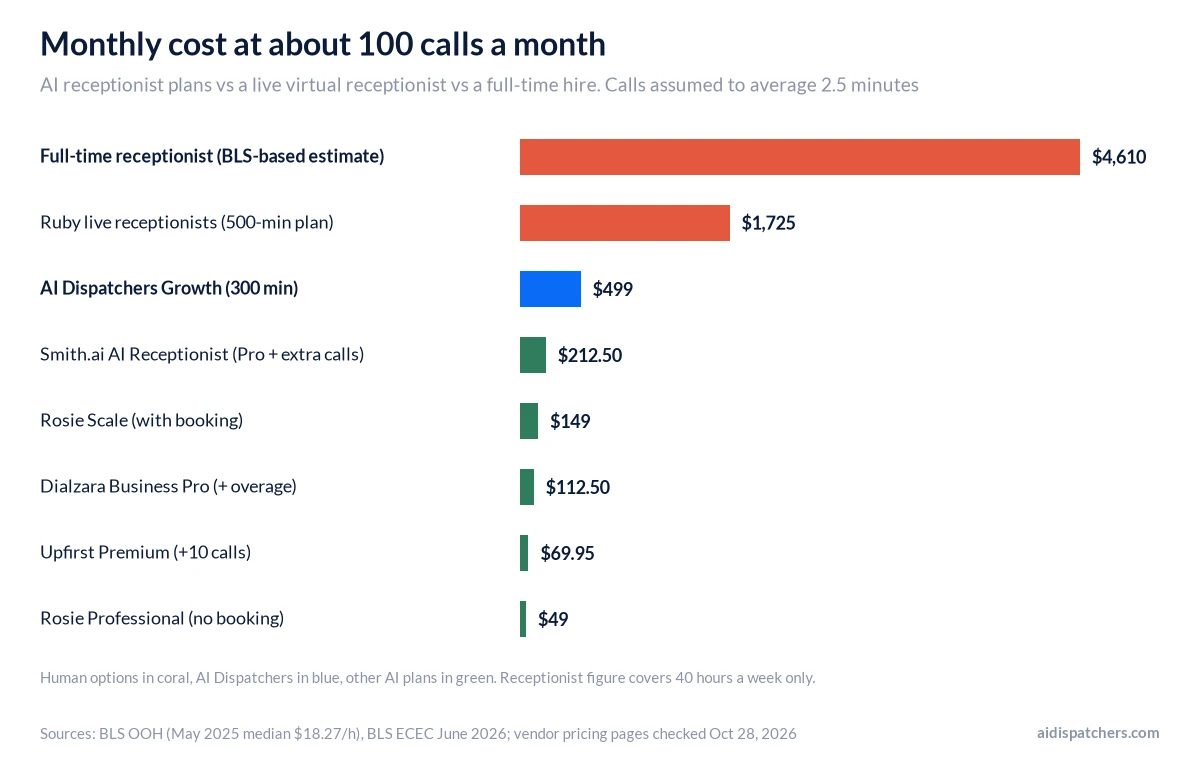
Here’s the money first, because that’s usually what people are really asking. At the national median wage, a full-time receptionist costs about $3,170 a month in pay alone and roughly $4,600 once benefits are added. At about 100 calls a month, the AI receptionist plans we priced came to roughly $50 to $500. That gap is real. So is the list of things software still does badly, and we’ll get to both.
Wage data from the U.S. Bureau of Labor Statistics. Vendor prices last checked October 28, 2026, on each company’s own pricing page.
How much does a human receptionist cost?
The median receptionist wage is $18.27 an hour, or $38,010 a year, according to the BLS (May 2025 data). Half earn more, half earn less. The bottom tenth earned under $13.83 an hour and the top tenth over $24.01, so your city matters a lot. In healthcare and social assistance, which employs 42% of all receptionists, the median was $19.00.
Pay isn’t the whole bill. The BLS Employer Costs for Employee Compensation survey for June 2026 found that for office and administrative support workers in private industry, wages were 68.7% of what employers spent. The other 31.3% went to paid leave, insurance, retirement, bonuses and overtime, and legally required costs like Social Security and unemployment insurance. Apply that split to the median wage and you get roughly $26.59 an hour.
| Line item | Full-time (40 hrs/week) | Part-time (20 hrs/week) |
|---|---|---|
| Wages at the $18.27 median | $3,167 a month ($38,010 a year) | $1,583 a month |
| Benefits and payroll costs (BLS averages) | About $1,443 a month | About $396 a month |
| Rough total | About $4,610 a month (about $55,300 a year) | About $1,979 a month |
| Hours the phone is covered | 40 of 168 hours in a week | 20 of 168 |
For part-timers we used the BLS split for part-time private industry workers, where wages made up 80% of compensation. Treat all of this as a ballpark. A two-person shop with no health plan will spend less; a dental office in a big metro, more. Hiring and training cost something too. Most receptionists learn on the job over a few days to a month, according to the BLS, and somebody on your team gives up that time to teach them.
How much does an AI receptionist cost?
Far less, and the way you pay is different. A person costs the same whether the phone rings five times or fifty. AI plans charge by the minute or by the call, so a slow month costs less and a busy one costs more. These are the published prices we found this morning:
| Service | How it’s priced | Published plans (checked Oct 28, 2026) |
|---|---|---|
| Upfirst | Per call | $24.95 for 30 calls ($1.50 per extra), $59.95 for 90, $159.95 for 300, $299 for 600 |
| Dialzara | Per minute | $29 for 60 minutes, $99 for 220, $199 for 500, $349 for 1,000; overage $0.35 to $0.48 a minute |
| Rosie | Per minute | $49 for 250 minutes (messages, no calendar booking), $149 for 1,000 with booking and live transfers, $299 for 2,000 |
| Smith.ai AI Receptionist | Per call | Free for 25 calls ($3 per extra), Pro $150 for 75 calls, $1.80 a call at 150, $1.67 a call at 300 |
| AI Dispatchers (ours) | Flat with minutes | Starter $299 for 100 minutes, Growth $499 for up to 300 minutes, Enterprise quoted |
For a business that gets about 100 calls a month, and assuming each call runs about 2.5 minutes, that works out to roughly $50 to $500 a month for AI, depending on the plan and what you need it to do. Booking straight into a calendar or transferring live calls often sits on a higher tier, so price the plan you’d actually use. Our own plans are near the top of that range, and on minutes alone, Rosie, Dialzara and Upfirst are cheaper. So is RingCentral’s AI Receptionist, at $49 for 100 minutes. If you want the full breakdown of how per-minute and per-call billing plays out, our guide to choosing an AI receptionist compares them side by side.
There’s a middle option too: live virtual receptionists, who are real people working remotely for many businesses. Ruby charges $250 for 50 minutes up to $1,725 for 500 minutes. At 100 calls a month (about 250 minutes), the smallest published plan that covers it is the $1,725 one. We broke down that market in our virtual receptionist cost guide.
What does a human receptionist do better?
Quite a lot. A good receptionist knows your regulars by voice. They hear it when a “quick question” is really a complaint headed for a one-star review, and they go get the owner. They’ll bend a rule for a longtime customer when that’s the right thing to do. Try writing that into a script.
Then there’s everything off the phone. Look at how the BLS describes the job: greet visitors, check people in, file paperwork, sort mail, type customer details into your system. Got a lobby or a waiting room? Somebody has to sit in it. Software can’t hand a patient a clipboard.
And plenty of callers simply want a person. In a Gartner survey of 5,728 customers (December 2023), 64% said they’d prefer companies didn’t use AI for customer service. Their top worry was that AI would make it harder to reach a human. You can still use AI. Just make the way out to a real person quick and obvious.
What does an AI receptionist do better?
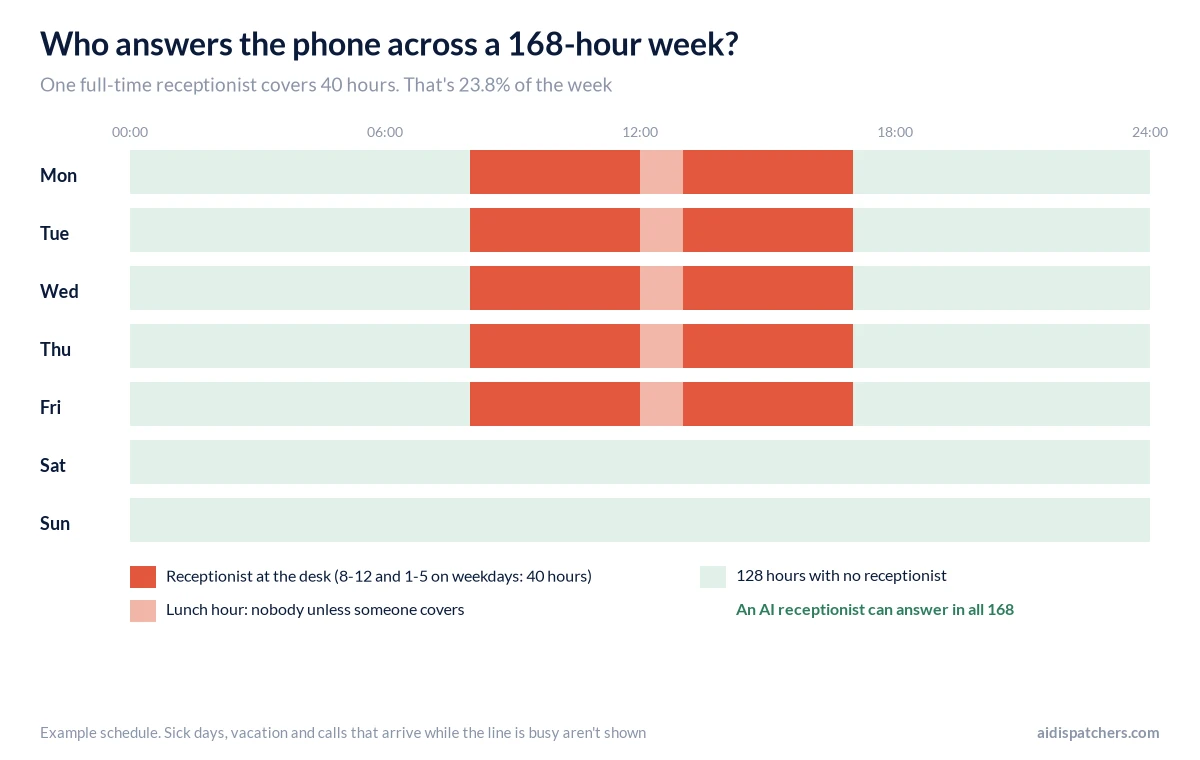
It’s there when nobody else is. A full-time receptionist covers 40 of the 168 hours in a week, which is under a quarter of them. The rest is nights, weekends, holidays, lunch breaks, sick days and the stretch when your receptionist is already on another line. A caller who reaches voicemail in those hours can just as easily ring the next business on the list. Our page on the real cost of missed calls walks through what that can add up to.
It’s also consistent. It asks the same intake questions on the hundredth call as on the first, and it doesn’t get short with the fourth price shopper of the afternoon. When you change a policy, you change it once.
The weak spot is the call nobody planned for. An AI can sound perfectly sure of itself and still get a detail wrong, and odd requests and angry callers are where that tends to happen. So write down when it should stop and hand off to a person. Then call it yourself a dozen times, from your own cell, before a customer ever does.
Which calls should go to a person, and which can AI take?
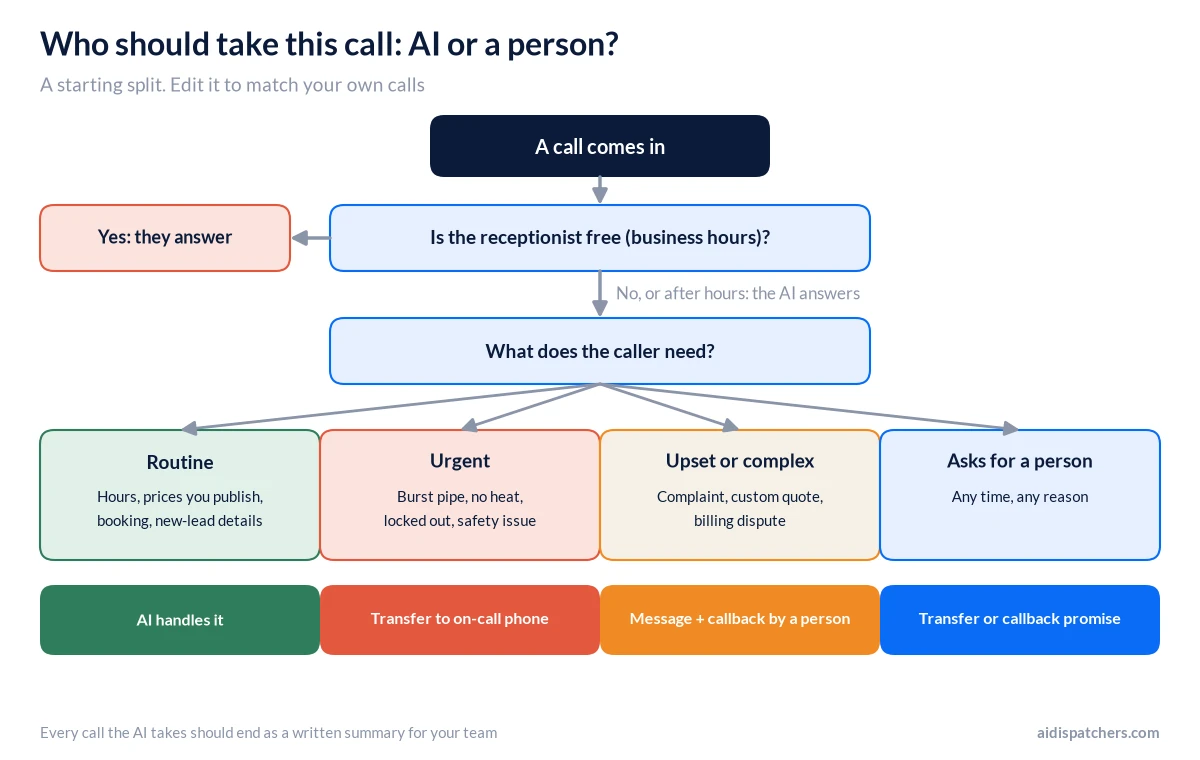
Pull up your call log from the last couple of weeks and go through it line by line. Mark each call routine or needs-a-human. The routine column may be longer than you’d guess. This is roughly how we’d sort it:
| Call | Good fit for AI | Better with a person |
|---|---|---|
| Hours, location, parking, “do you do X?” | Yes | |
| Booking, moving or cancelling an appointment | Yes, if it books on a plan you’ve tested | When the schedule has lots of exceptions |
| New lead calling after hours | Yes: take details and a callback time | The callback itself, next morning |
| Urgent problem (burst pipe, no heat, locked out) | Collect details, then transfer to your on-call phone | Whoever’s on call |
| Upset customer or complaint | Take a message if no one’s free | Yes |
| Pricing on a complex or custom job | Give your published ranges only | Yes |
| Visitors at the front desk | No | Yes |
Is an AI receptionist worth it for a small business?
If you don’t have a receptionist now and calls are going to voicemail, it’s usually the cheap fix. Even our pricier plan costs about a tenth of a full-time hire. If the business already has a great front-desk person, AI shouldn’t replace them. Put it on the overflow and after-hours calls so they aren’t stuck taking messages while a customer waits at the counter.
Hiring wins outright when the front desk is the job. Think walk-ins all day, forms, card payments, people checking in for appointments. You’d need someone standing there regardless, and answering the phone comes with the chair.
Will AI replace receptionists?
Not quickly, by the government’s numbers. The BLS projects receptionist jobs to shrink 2% between 2025 and 2035, from about 947,500 to 931,600, with around 105,100 openings a year as people retire or move on. It says growth is held back because organizations keep automating front-office work. That’s a slow decline, not a wipeout, and it matches what we see: the phone part of the job is moving to software faster than the front-desk part.
How to use AI and a person together
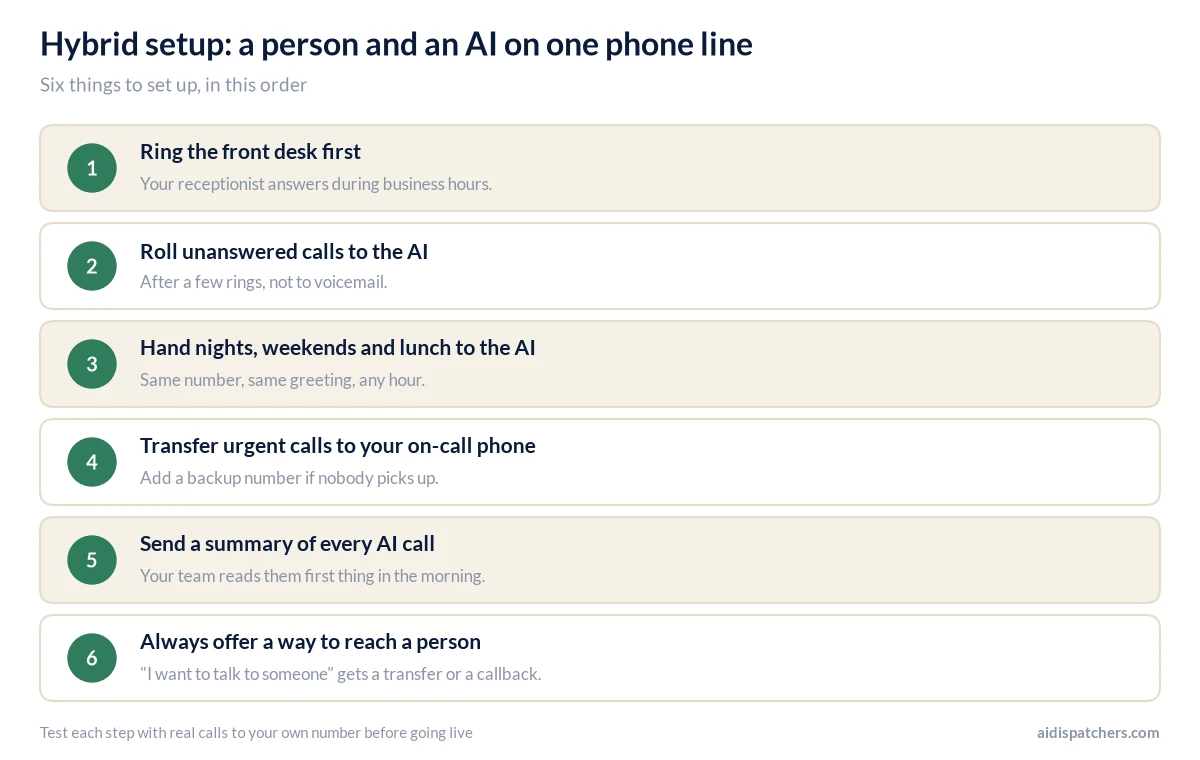
The setup we’d suggest for most small offices looks like this:
- Your receptionist answers during business hours. If they don’t pick up within a few rings, the call rolls to the AI instead of voicemail.
- Nights, weekends and the lunch hour go to the AI.
- Urgent calls get transferred to whoever’s on call, with a backup number if they don’t answer.
- Every call the AI handles lands as a short summary your team reads first thing in the morning.
- Anyone who asks for a person gets one, either a live transfer or a firm callback time.
If you’re also weighing a traditional answering service, our AI receptionist vs answering service comparison covers that choice, and the answering service cost guide has the per-minute math.
Where AI Dispatchers fits
We sell an AI voice agent, so take this section for what it is. Our Starter plan is $299 a month with 100 minutes and covers answering, booking and SMS confirmations. Growth is $499 for up to 300 minutes and adds emergency escalation and live transfers, which is the plan you’d want for the hybrid setup above. Both include setup and onboarding. We’re more expensive than several AI options in the table, so if all you need is message taking, one of the cheaper plans may suit you better. If you’d like to see how it would handle your calls, book a demo or send us a note with the form below.
Questions people ask about AI and human receptionists
Is an AI receptionist better than a human receptionist?
Neither is better across the board. AI wins on hours and cost per call: it can answer at 3 a.m. and on holidays for a monthly fee in the tens or hundreds of dollars. A person wins on judgment, upset callers and anything that happens at the front desk. Many small businesses use both.
How much does a receptionist cost per month?
At the BLS median of $18.27 an hour, a full-time receptionist earns about $3,167 a month. Add benefits and payroll costs at the BLS average share for office workers and it’s roughly $4,610 a month. Your local wage rates and whether you offer health insurance will move that number.
How much does an AI receptionist cost?
Published plans we checked on October 28, 2026 start at $0 (Smith.ai’s free tier, 25 calls) and $24.95 (Upfirst, 30 calls), and most small-business plans fall between about $50 and $500 a month. Watch for features like calendar booking and live transfers sitting on a higher tier than the cheapest plan.
Is an AI receptionist worth it?
For a lot of businesses, yes. The clearest case is a phone that goes to voicemail whenever you’re busy, or a front desk buried in the same few questions about hours and prices. It’s harder to justify when you only get a few calls a week, or when nearly every call is a detailed quote that a person ends up handling anyway.
Will AI replace receptionists?
The BLS expects a slow decline, not a disappearance: receptionist jobs are projected to fall 2% from 2025 to 2035, with about 105,100 openings a year. Phone answering is the part most likely to move to software. Greeting visitors and handling paperwork in person is harder to automate.
Do customers mind talking to an AI receptionist?
Plenty do. Gartner surveyed 5,728 customers and found 64% would rather companies didn’t use AI for customer service. What bothered them most was getting stuck without a way to reach a person, so make that easy: one spoken request should get a human or a callback.
Should I hire a part-time receptionist or use AI?
A 20-hour-a-week receptionist at the median wage runs roughly $1,600 to $2,000 a month with payroll costs, and covers 20 of the 168 hours in a week. If your calls are mostly routine and spread across the day and evening, AI covers more hours for less. If you need someone in the office for visitors, a part-timer still makes sense, with AI on the hours they’re out.
Can an AI receptionist transfer calls to a real person?
Most can, but check which plan includes it. Rosie, for example, lists live call transfers on its $149 plan rather than the $49 one, and AI Dispatchers includes transfers on Growth. Test it with a real call to your own cell phone before you rely on it.
Talk to us about your calls
Tell us a little about your business and a specialist will get back to you. Fields marked * are required.