
A bilingual answering service picks up your business calls in English and Spanish, takes the message or books the job, and sends you the details. Of the six live services we checked, four include Spanish at no extra cost and two charge for it. AI receptionists mostly switch languages by themselves. So price isn’t where these services really differ. When is Spanish actually staffed? How does a caller get to a Spanish speaker? And what language do your messages come back in?
This guide covers those details, then puts eleven services side by side at 40 and 120 calls a month. If you only get a few Spanish calls a week, there’s also a cheaper setup near the end that may be all you need.
Prices and Spanish terms: checked October 31, 2026 on each vendor’s own pricing or bilingual page. Population figures: U.S. Census Bureau, 2024 American Community Survey 1-year estimates, table B16001.
How many of your callers might prefer Spanish?
Quite a few. In the Census Bureau’s 2024 American Community Survey, 44.9 million people age 5 and older spoke Spanish at home. That’s 13.9% of that population. About 18.4 million of them, or 41%, told the Census they speak English less than “very well.”
That second number is the one to think about. Plenty of bilingual customers will happily talk to you in English. The 18 million who’d struggle are the people who hear an English-only greeting, guess at which button to press, and hang up.
The national figure won’t tell you much about your own phone, though. Spanish is far more common in some counties than others. To see your area, open table B16001 on data.census.gov and filter by your county. Then look at last month’s missed calls and voicemails. If you’ve been getting hang-ups, or messages you couldn’t understand, that’s your real demand.
How a Spanish caller actually reaches Spanish
The word “bilingual” on a pricing page covers at least four setups. They sound alike in a sales call and very different to the person dialing, so ask which one you’d get.
- A language menu. The caller hears “press 1 for English, 2 for Spanish” before anyone answers. PATLive includes a free auto attendant for this. It’s simple and clear, but it’s one more step before a human picks up.
- Transfer from an English-speaking operator. Whoever answers hears Spanish and passes the call along. Ruby says its English-only receptionists say “un momento, por favor” and transfer the caller to a bilingual coworker. AnswerConnect’s basic Spanish option works the same way. Callers wait a few extra seconds, and you don’t pay for a separate line.
- Spanish first, or a dedicated Spanish number. Your calls (or calls to a second number you advertise in Spanish) go straight to a bilingual receptionist. AnswerConnect calls its version Spanish premium. Smith.ai sells a “dedicated Spanish line” where every call is answered in Spanish, for $1.00 a call.
- An AI that detects the language. The caller just talks. Smith.ai says its AI Receptionist, once Spanish is turned on, detects English or Spanish and carries on in that language. Dialzara and Upfirst say theirs switch automatically too. Restaurant tools can be less clear: our Slang AI review found Spanish listed in Core on its US pricing page but under Premium on the Canadian and Australian versions.
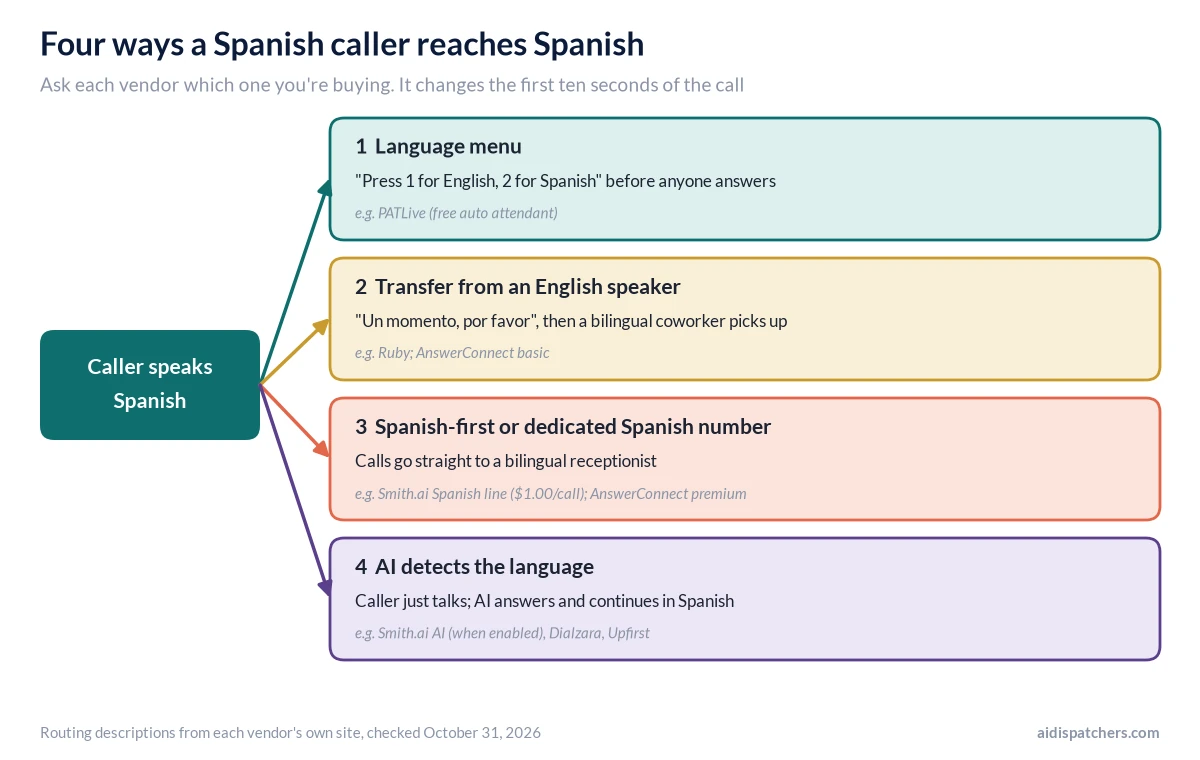
None of these is wrong. A menu works fine for an office where most callers already know what they want. A dental practice or law firm with a big Spanish-speaking client base would probably rather skip the menu and the transfer, and send those callers to a dedicated number. AI detection works well when callers mix both languages, which many bilingual callers do without thinking about it.
Spanish hours aren’t always the same as English hours
This is the detail most comparison tables miss. A service can answer in English around the clock and still have Spanish speakers on shift only part of the day.
- PATLive answers in English 24/7. Its bilingual page says Spanish-speaking receptionists are available from 8 a.m. to 10 p.m. Eastern. For a business on Pacific time, that’s 5 a.m. to 7 p.m.
- Posh says in its FAQ that it guarantees Spanish answering Monday through Friday, 9 a.m. to 6 p.m. Eastern. Its bilingual page lists 8 a.m. to 6 p.m. Outside those hours, Spanish callers can go to a Spanish voicemail greeting or an English-speaking receptionist, or to a bilingual one if someone happens to be free.
- Ruby, Abby Connect and AnswerConnect all say their Spanish answering runs 24/7.
- AI receptionists don’t have shifts, so Spanish is available whenever the AI is answering.
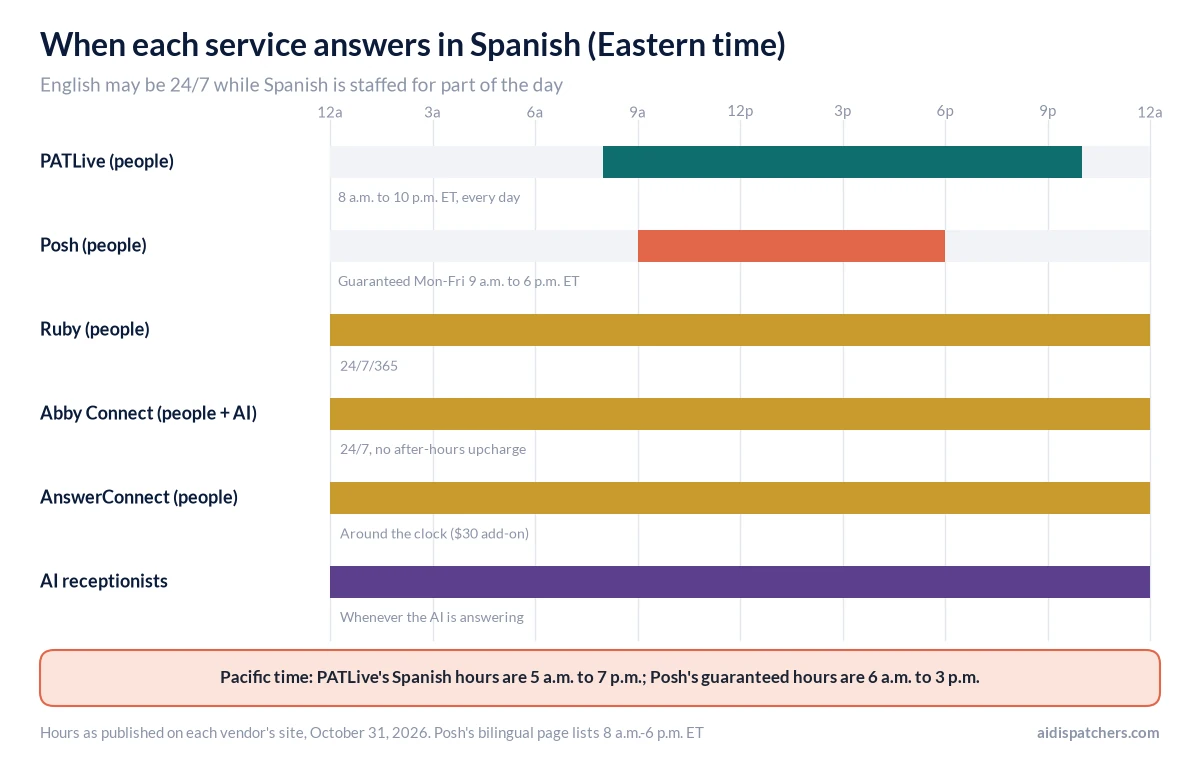
So think about when your Spanish calls come in. A roofer whose customers call after work, or a restaurant taking orders at 9 p.m. Pacific, could find the Spanish team has gone home on some plans. A plumber who gets emergency calls at 2 a.m. needs to know exactly what happens to a Spanish-speaking caller at that hour. Ask each vendor in writing.
What a bilingual answering service costs
We priced two months for every service. A quiet one with 40 calls, and a busier one with 120. PATLive’s pricing page pegs 100 minutes at about 40 calls, so we used 2.5 minutes a call: 100 minutes for the quiet month, 300 for the busy one. For per-call Spanish fees we assumed one caller in three speaks Spanish. Each figure is the cheapest published plan, or plan plus overage, that covers the month.
| Service | Who answers | 40 calls / 100 min | 120 calls / 300 min | What its own site says about Spanish |
|---|---|---|---|---|
| PATLive | People | $189 | $479 | “No bilingual fees”; Spanish 8 a.m. to 10 p.m. ET |
| Posh | People | $215 | $630 | No additional charge; guaranteed weekdays 9 to 6 ET |
| Abby Connect | People (AI option) | $329 | about $899 | Included on every plan, people and AI, 24/7 |
| Ruby | People | $395 | $720 plus overage | Included in all plans, 24/7 |
| AnswerConnect | People | $380 + $49.99 setup | $425 | “Spanish Call Answering” add-on, $30 |
| Smith.ai receptionists | People | $428 | $1,165 | Dedicated Spanish line, $1.00 a call |
| Smith.ai AI Receptionist | AI | $150 | $270 | Detects Spanish when enabled; no Spanish price listed |
| Rosie | AI | $49 | $149 | “English & Spanish on every call” |
| Dialzara | AI | $99 | $135 | Bilingual EN/ES from the $99 Pro plan, not on the $29 Lite plan |
| Upfirst | AI | $39.95 | $89.95 | 35+ languages, switches automatically |
| AI Dispatchers | AI | $299 | $499 | Language options aren’t listed on our pricing; ask us |
How we got these: PATLive 100- and 300-minute plans. Posh $215 for 100 minutes; $420 for 200 plus 100 at $2.10. Abby $329 for 100 Abby Minutes; $599 for 200 plus 100 at its plan minute rate, which Abby doesn’t print in dollars ($599 / 200 = $2.995). Ruby $395 for 100 minutes; for 300 minutes, the $720 plan for 200 plus overage at a rate Ruby doesn’t publish, or $1,725 for 500. AnswerConnect Entry $350 for 200 minutes or Growth $395 for 300, plus $30 from its price list PDF (its bilingual page calls it “a small additional charge per month”). Smith.ai $300 for 30 calls plus 10 at $11.50, or $810 for 90 plus 30 at $10.50, plus $1.00 on 13 or 40 Spanish calls. Smith.ai AI $150 for 75 calls, or 150 calls at $1.80. Rosie $49 for 250 minutes, $149 for 1,000. Dialzara Pro $99 for 220 minutes plus 80 at $0.45. Upfirst $24.95 for 30 calls plus 10 at $1.50; $59.95 for 90 plus 30 at $1. Taxes and other add-ons not included.
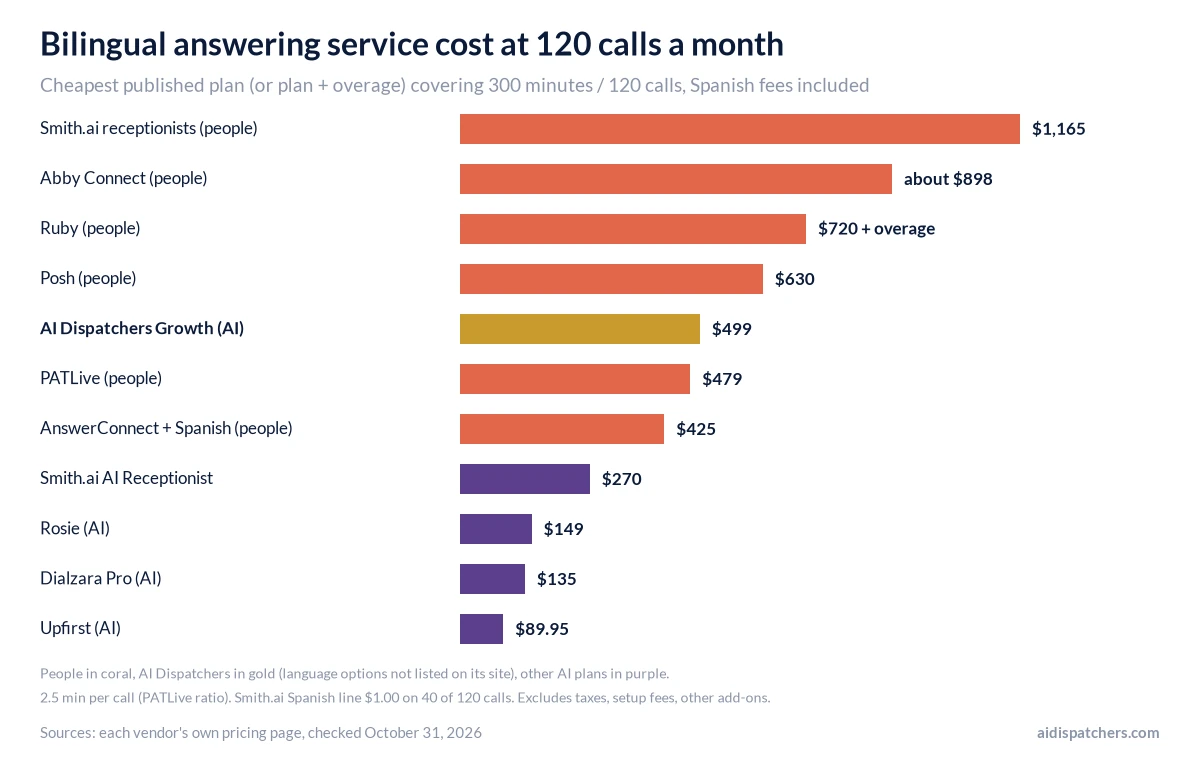
A few things stand out. Spanish itself is rarely the expensive part anymore. Only two of the live services charge for it at all, and AnswerConnect’s $30 is flat, so it barely matters at higher volume. Smith.ai’s per-call fee grows with your Spanish volume, but its per-call billing also means a long Spanish intake call costs the same as a short one. The bigger cost driver is the same as with any answering service: how many minutes your calls use, and whether a person or an AI is answering.
For comparison, the Bureau of Labor Statistics puts the median receptionist wage at $18.27 an hour, or $38,010 a year, as of May 2025. BLS doesn’t publish a separate figure for bilingual receptionists, so treat that as a floor rather than what a Spanish-speaking hire will cost you. We worked through the full hire-versus-service math in our AI receptionist vs human receptionist guide.
What to translate before the first Spanish call
Every service on that list will tell you its Spanish speakers follow your script. Fine, but someone has to write the Spanish version, and on most accounts that’s partly on you. AnswerConnect says each of its Spanish options comes with a full script translation. Smith.ai says its AI translates your prompts and FAQs in real time. Either way, check what comes out.
Here’s what needs a Spanish version:
- Your greeting, with the company name said the way your customers say it.
- The intake questions, in the same order as the English ones, so your team can read messages from both languages the same way.
- Emergency rules. What counts as urgent, who gets called, and the line the service uses when someone should hang up and dial 911.
- Prices and service names. Only the ones you’d quote in English, plus the short list of things nobody should promise.
- Spelling rules for names. Many Spanish-speaking callers give two surnames, and accents matter. Tell the service whether to record both surnames, or you’ll end up with duplicate customer records.
If nobody on your team reads Spanish well, pay a native speaker for an hour to review the script. A literal translation of “Can I grab your info real quick?” doesn’t sound the way anyone actually talks.
Then decide what language you want the messages in. The vendors don’t agree here. Ruby says its receptionists pass Spanish callers’ details to you in English. Abby says your team gets every summary and transcript in English. Dialzara does the opposite, delivering a Spanish caller’s message in Spanish. Upfirst translates the transcript into your language. If the person returning calls doesn’t speak Spanish, an English summary is what you want. If a bilingual staff member calls everyone back, the original Spanish wording can catch things a summary loses.
Six test calls to make in Spanish before you sign
Most services in the table let you try them free first, so use that window. Rope in a fluent friend, a cousin, or that regular customer who’s always chatty, and hand them this list:
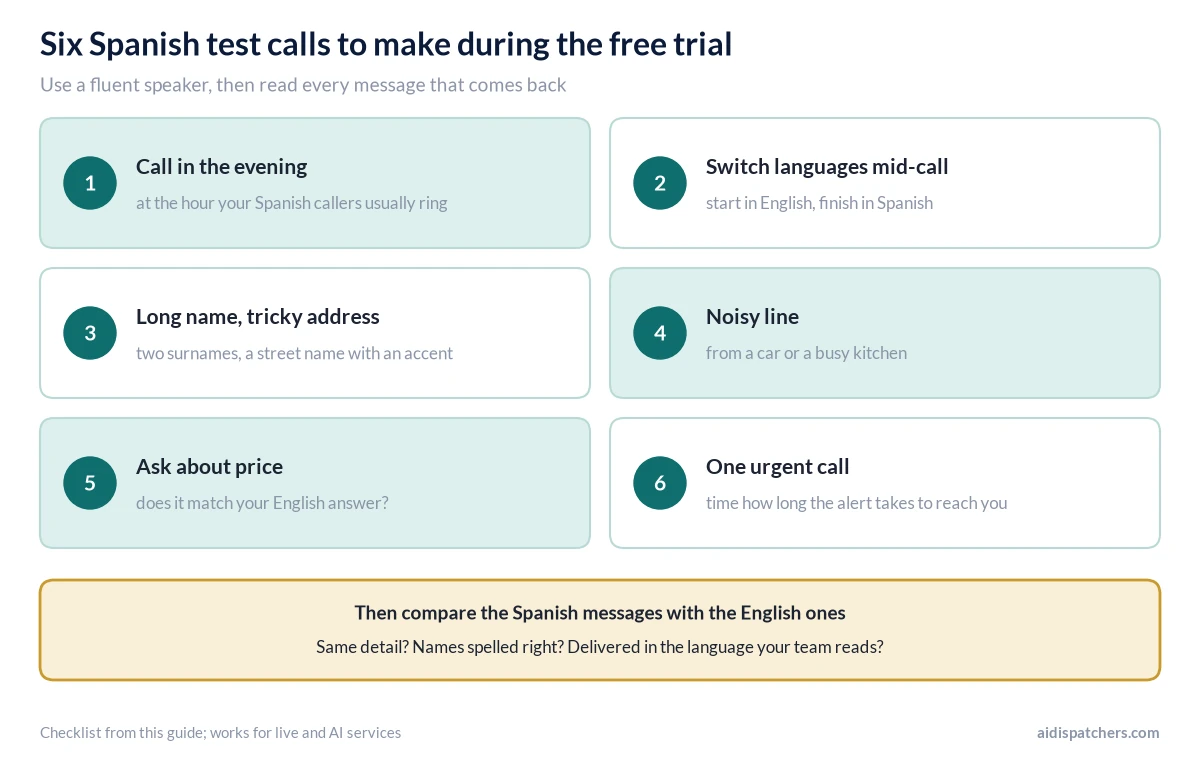
- Call in the evening, at the hour your Spanish callers usually ring, and see who answers.
- Start in English and switch to Spanish halfway through. Does the receptionist or AI follow, or start over?
- Use a real-world name. Two surnames, a street like Calle Peñasco, a callback number read quickly. Then see how it’s spelled in the message.
- Call from a car or a noisy kitchen. Real customers don’t call from a quiet room.
- Ask what a service call costs. You want the same number your English script gives, not a guess.
- Fake an emergency (a leak, a lockout, whatever’s urgent in your trade). Note the time, then note when your phone buzzes.
When the messages land, lay a Spanish one beside an English one from the same day. Check the small stuff: the cross street, the second surname, the note about the dog in the yard. Better you spot that during a trial than after a customer gets the wrong callback.
When a full bilingual service is more than you need
If you get a handful of Spanish calls a month and someone on staff speaks Spanish, a simpler setup might do. Add a short Spanish line to your voicemail greeting and have that person return those calls each day. Something like:
“Gracias por llamar a Plomería López. Por favor, deje su nombre, su número de teléfono y el motivo de su llamada. Le devolveremos la llamada lo antes posible.”
(Thanks for calling López Plumbing. Please leave your name, phone number and the reason for your call. We’ll call you back as soon as possible.)
It’s free, and it’s much better than an English-only greeting. The catch is speed: a caller with a burst pipe or a toothache won’t wait for tomorrow’s callback. Once Spanish calls are coming in after hours or while your bilingual person is busy, an after-hours answering service or an overflow setup starts to pay for itself. Our outsourced phone answering guide walks through the overflow and after-hours forwarding options.
Where AI Dispatchers fits
AI Dispatchers is an AI receptionist. It answers in your business name, books appointments during the call and texts confirmations. Starter is $299 a month for the first 100 minutes. Growth is $499 for up to 300 minutes and adds priority escalation and call transfers. So we cost more than the budget AI plans in the table, and less than most live services at the busier volume.
One thing we can’t tell you from our own website: whether Spanish is available, because our pricing section doesn’t mention languages. So ask us on a demo call, and get the answer in writing. Then run the six test calls from this guide during the trial, same as you would with anyone else. Still comparing AI tools? Our guide to choosing an AI receptionist has a longer checklist. For live-receptionist plans in more detail, see virtual receptionist cost.
Bilingual answering service FAQ
How much does a bilingual answering service cost?
Based on published prices we checked on October 31, 2026, about 40 calls a month costs roughly $40 to $300 with an AI receptionist and about $190 to $430 with live receptionists. At 120 calls a month the live services run from about $425 to over $1,100. Per-minute plans get more expensive if your Spanish calls run longer, so time a few before you pick a plan.
Do answering services charge extra for Spanish?
Most of the live services we checked don’t. PATLive, Posh, Abby Connect and Ruby all say Spanish is included. AnswerConnect lists Spanish Call Answering as a $30 add-on, and Smith.ai charges $1.00 a call for its dedicated Spanish line. Ask whether the price covers Spanish at every hour or only during the day.
Can an AI receptionist answer calls in Spanish?
Many can. Rosie, Upfirst and Dialzara say theirs answer in Spanish and switch automatically when the caller does, and Smith.ai says its AI detects Spanish once you turn it on. Check which plan includes it (Dialzara starts at its $99 plan) and listen to a few test calls with a fluent speaker before you go live.
Is a bilingual answering service available 24/7?
Not always. Ruby, Abby Connect and AnswerConnect say their Spanish answering runs around the clock. PATLive offers Spanish from 8 a.m. to 10 p.m. Eastern, and Posh guarantees it on weekdays from 9 a.m. to 6 p.m. Eastern. AI receptionists answer in Spanish whenever they’re on.
How much does a bilingual receptionist make?
The Bureau of Labor Statistics doesn’t publish a separate wage for bilingual receptionists. For all receptionists, the median was $18.27 an hour, or $38,010 a year, in May 2025. Expect to pay at least that, plus payroll costs, for someone who can handle calls well in both languages.
What should a Spanish voicemail greeting say?
Keep it short: thank them for calling, ask for their name, phone number and the reason for the call, and say when you’ll call back. For example: “Gracias por llamar a Plomería López. Por favor, deje su nombre, su número de teléfono y el motivo de su llamada.” Only promise a callback time you can keep.
What percentage of the U.S. speaks Spanish at home?
About 13.9% of people age 5 and older, or 44.9 million, according to the Census Bureau’s 2024 American Community Survey. Around 41% of them said they speak English less than “very well.” The share varies a lot by county, so check table B16001 for your own area.
Do I need a bilingual answering service if I already have a bilingual employee?
Maybe not during the hours they work. The gap is when they’re off, at lunch or on another call, because that’s when Spanish callers reach voicemail. Many businesses keep the employee as the first line and add a bilingual service for overflow and after-hours calls.
Talk to us about your calls
Tell us a little about your business and a specialist will get back to you. Fields marked * are required.