
Virtual receptionist cost depends less on the company you pick than on how many minutes you use and how that company counts them. The cheapest live plans we found start at $49 a month (PATLive, pay as you go at $2.99 a minute) and $65 (Posh). A 100-minute plan costs anywhere from $189 at PATLive to $395 at Ruby. Above 100 minutes, the gaps get wide.
This guide covers seven remote receptionist companies: Ruby, Posh, PATLive, Abby, AnswerConnect, Davinci and Smith.ai. We read every price off the company’s own pricing page, then worked out real monthly bills at 100 and 300 minutes. You’ll also see how each one counts a “minute” (they don’t agree), what a hired receptionist costs according to the Bureau of Labor Statistics, and where AI receptionists fit.
Prices last checked October 19, 2026, on each company’s own pricing page.
What is a virtual receptionist, and how is it priced?
A virtual receptionist is a real person who answers your business line from somewhere else. Calls forward from your number (or you use one they give you), and the receptionist greets callers in your company’s name, takes messages, transfers calls and, on many plans, books appointments. You pay a monthly plan instead of a salary.
Almost every company bills one of two ways. Most sell a bucket of receptionist minutes with a per-minute rate once you run out. Smith.ai is the well-known exception: it sells a bucket of calls, so a 40-second call and a 9-minute call cost the same. AI receptionists, which are software rather than people, are priced differently again, and we cover them further down.
How much does a virtual receptionist cost?
So how much is a virtual receptionist? Here are the published plans. Entry prices look close together. The gaps open up in the overage rates and in what each company leaves off the page.
| Company | How it bills | Published monthly plans | Extra minutes or calls | Setup, trial and terms |
|---|---|---|---|---|
| Ruby | Receptionist minutes, rounded up to the next minute | $250 (50 min), $395 (100), $720 (200), $1,725 (500) | Overage rate isn’t shown on the pricing page | No activation, onboarding or setup fees, per its page |
| Posh | Receptionist minutes | $65 (no minutes, $2.30 each), $130 (50), $215 (100), $420 (200), $700 (350), $975 (500), $1,900 (1,000) | $2.20 a minute on the 50-minute plan, falling to $1.90 | No other fees, per its FAQ. Free trial of 7 days or 250 minutes. Month to month. |
| PATLive | Minutes, live time on calls only | $49 (pay as you go, $2.99 a minute), $99 (50 min), $189 (100), $349 (200), $479 (300), $759 (500), up to $6,899 (5,000) | $2.29 a minute on the 50-minute plan, falling to $1.49 | 14-day free trial. No contracts. Government taxes and fees extra. |
| Abby | “Abby Minutes” (an AI-answered minute counts as half) | $164 (50), $329 (100), $599 (200), $1,380 (500) | Billed at your plan’s Abby Minute rate; the number isn’t printed | No setup fee. Free trial on every plan. Month to month. |
| AnswerConnect | Minutes, every interaction rounded up to the next minute | $350 (200 min), $395 (300), $575 (400), larger plans up to 100,000 minutes | $2.50 a minute on Entry, $1.85 on Growth and Standard | $49.99 setup fee on Entry and Standard, none on Growth |
| Davinci | Live answer minutes | Business $129 (50 min) or $239 (100); Premium $249 (50) or $319 (100) | Not shown on the page | Appointment scheduling and outbound calls are Premium features |
| Smith.ai | Per call | $300 (30 calls), $810 (90), $2,100 (300) | $11.50, $10.50 or $8.50 a call, by plan | No setup fees. 30-day money-back guarantee (capped at $1,000). Booking is $1.50 a call extra. |
Divide the plan price by the minutes and you get a feel for the spread. Ruby’s 50-minute plan works out to $5.00 a minute and its 500-minute plan to $3.45. Posh’s 100-minute plan is $2.15 a minute and PATLive’s is $1.89. AnswerConnect’s 300-minute Growth plan comes to about $1.32. Smith.ai’s Starter is $10 a call.
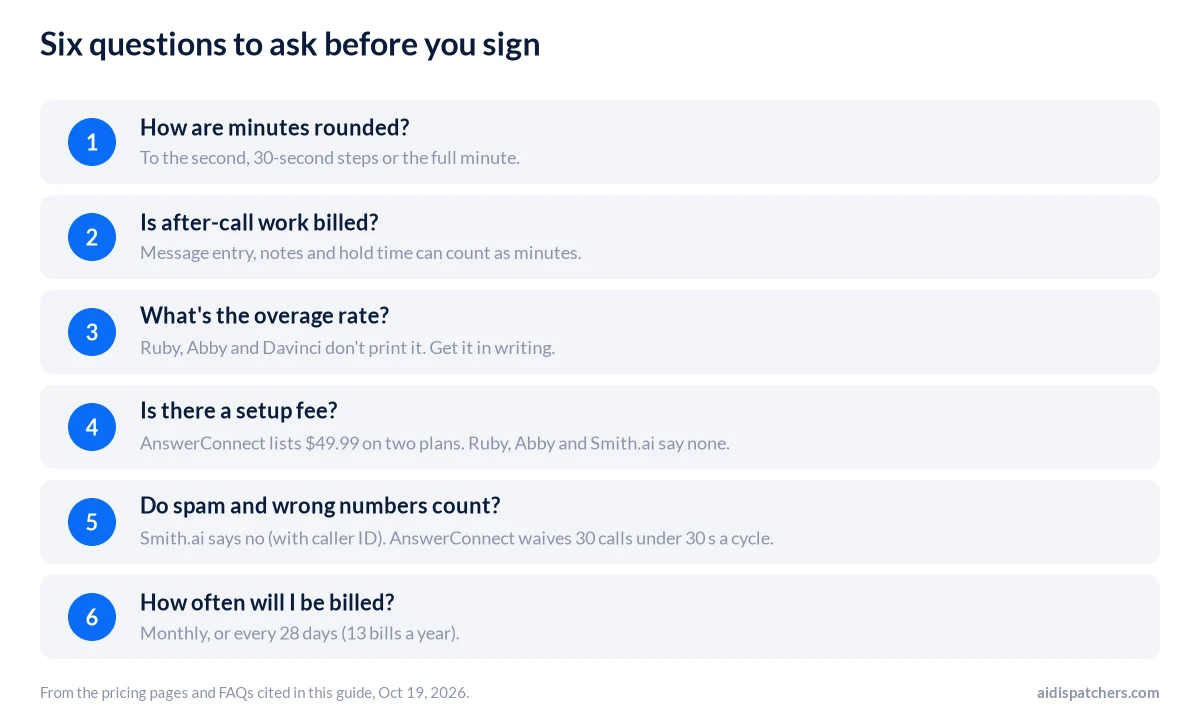
Three of the seven don’t publish an overage rate: Ruby, Abby and Davinci. That matters more than it sounds, because you can’t price a busy month without it. Ruby’s FAQ says extra minutes are billed “according to the overage rate associated with your plan” and that its app alerts you at 85% and 100% of your minutes, so you’ll at least see it coming. Ask for the number in writing before you sign.
What counts as a receptionist minute?
Two plans with the same price can bill the same call differently. Each company defines a minute its own way, and the definition usually lives in the FAQ, not on the price card.
- Ruby bills in 60-second increments, rounded up. Its FAQ gives the example of a 10-second call billed as 60 seconds. The clock runs from when the receptionist picks up until they transfer the call, send it to voicemail or hang up, and it includes hold time and any time spent finishing your message after the caller is gone.
- AnswerConnect rounds every interaction up to the nearest minute too. It doesn’t charge for the first 30 interactions under 30 seconds in each billing cycle, which softens the hit from hang-ups and wrong numbers.
- Posh bills for phone time and also for time spent “completing an activity” for your account. Scheduling, follow-ups and sending you the message all count.
- PATLive says it bills only for time receptionists are live on your calls and doesn’t charge for after-call notes, message entry or wrap-up.
- Smith.ai sidesteps the question by charging per call. It says spam and unsolicited sales calls don’t count against your quota, as long as the lines you forward pass caller ID.
Ruby’s own pricing guide has a handy example. Take a call that lasts 1 minute 12 seconds. Billed to the second, that’s 1.2 minutes. In 30-second steps it’s 1.5. Rounded up to the full minute, it’s 2. Now picture 100 calls like that in a month (a made-up month, just to show the effect). That’s 120, 150 or 200 billable minutes for exactly the same calls. The last figure is two-thirds more than the first.
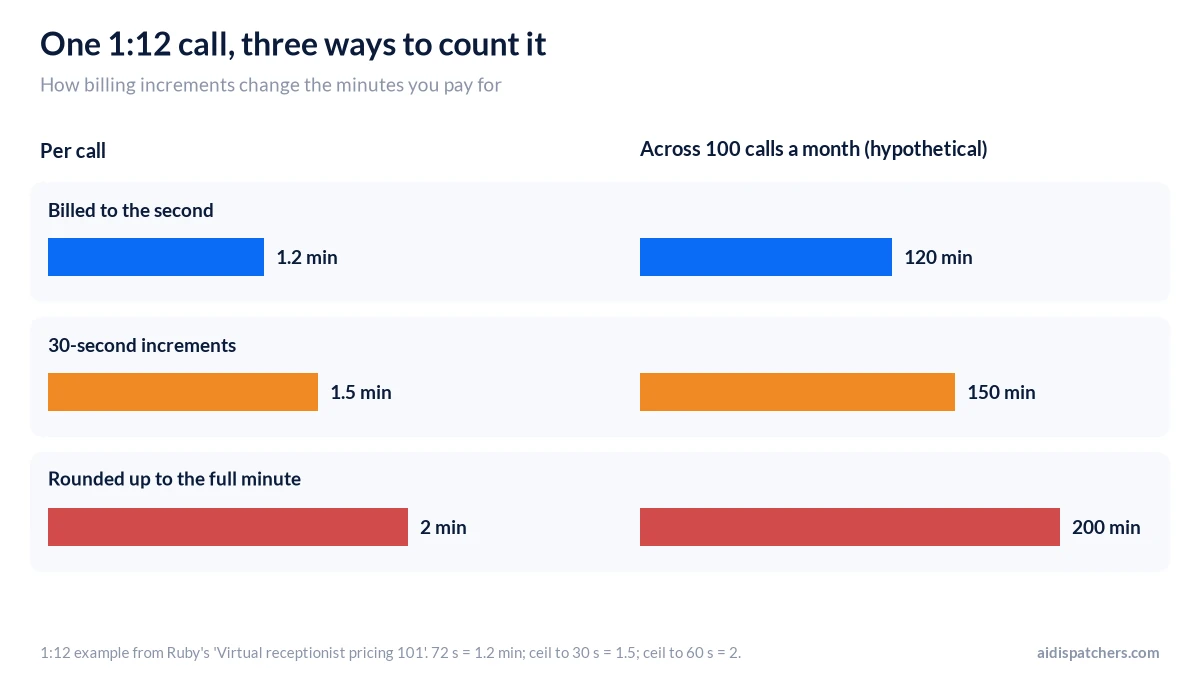
None of this makes one company the villain. Ruby and AnswerConnect both round up, and both say so plainly. It just means the per-minute rate on the page isn’t the whole price. If your calls are short (hours, directions, “is the shop open Saturday?”), rounding and after-call work can be a big share of your bill.
What would 100 or 300 minutes a month actually cost?
We priced two volumes at each company, choosing the cheapest published plan that covers the usage. PATLive’s page puts 50 minutes at “about 20 calls,” or 2.5 minutes a call, so 100 minutes is roughly 40 calls and 300 minutes roughly 120. We used that ratio to convert minutes to calls for Smith.ai. Your own call length will move these numbers, so treat them as a model and not a quote.
| Company | 100 minutes (about 40 calls) | 300 minutes (about 120 calls) |
|---|---|---|
| PATLive | $189 (100-minute plan) | $479 (300-minute plan) |
| Posh | $215 (100-minute plan) | $630 ($420 for 200 minutes + 100 at $2.10) |
| Davinci | $239 Business or $319 Premium | Can’t be priced: no overage rate published |
| Abby | $329 (100 Abby Minutes, all human) | Can’t be priced exactly: overage rate not printed |
| AnswerConnect | $350 (200-minute Entry plan) plus a $49.99 setup fee | $395 (300-minute Growth plan, no setup fee) |
| Ruby | $395 (100-minute plan) | $720 for 200 minutes plus 100 at an unpublished rate, or $1,725 for 500 |
| Smith.ai | $415 ($300 for 30 calls + 10 at $11.50) | $1,125 ($810 for 90 calls + 30 at $10.50) |
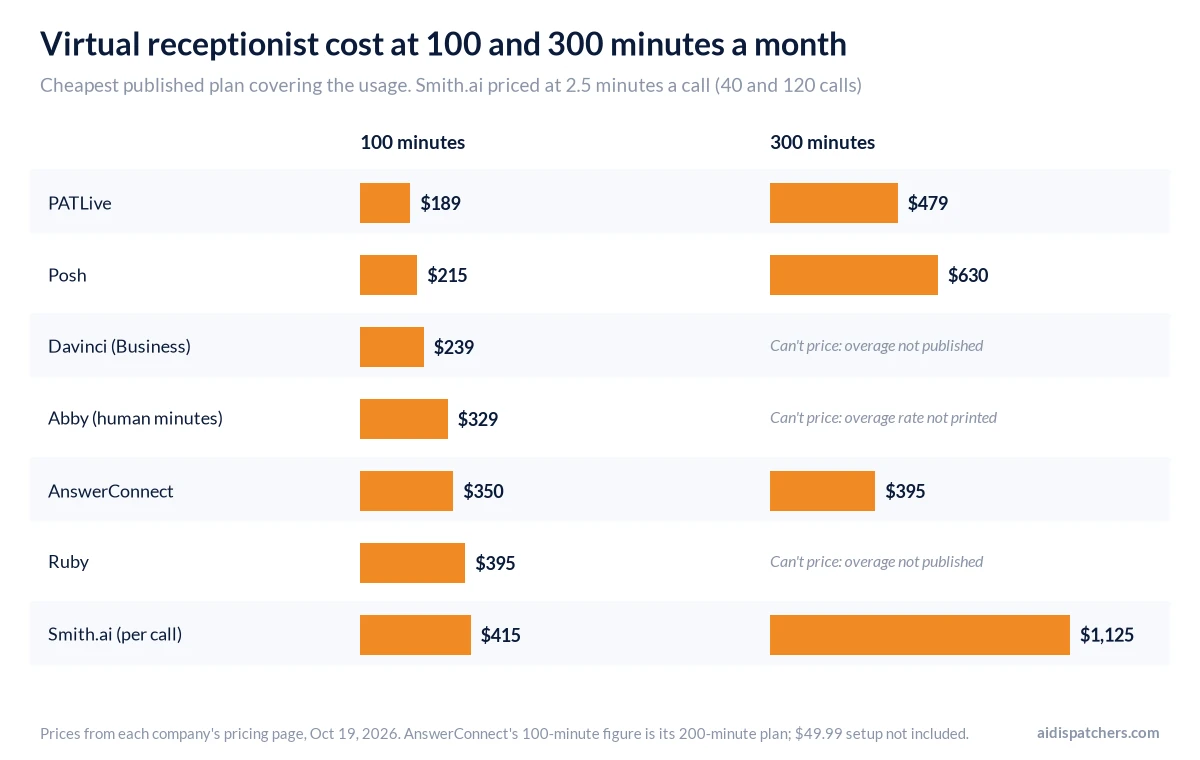
AnswerConnect is the surprise. Its smallest plan is 200 minutes, so it looks pricey for a light month, then comes out cheapest at 300. Smith.ai goes the other way at 2.5-minute calls: the priciest at 100 minutes and, at 300, beaten only by buying Ruby’s 500-minute plan. Long calls change that. A nine-minute legal intake costs the same at Smith.ai as a 40-second question, while a per-minute plan bills all nine minutes.
Features aren’t equal either. Davinci’s scheduling sits on its Premium plans, and Smith.ai charges $1.50 per booked appointment. Ruby, Posh and PATLive say their call-handling features come with the plan, though Ruby’s pricing guide lists a few paid extras such as custom hold music and additional phone lines.
What if you only get a handful of calls?
Then a pay-as-you-go plan is the affordable virtual receptionist option. At 20 minutes a month, PATLive’s $49 plan comes to $108.80 and Posh’s $65 Chic plan to $111. Davinci’s smallest plan is $129 for 50 minutes. PATLive’s 50-minute plan ($99) beats its own pay-as-you-go plan once you pass about 17 minutes a month, and Posh’s 50-minute plan beats Chic past about 28 minutes. Posh’s FAQ shows the math itself: 15 minutes on Chic is $65 plus 15 times $2.30, or $99.50.
What fees get added to a virtual receptionist bill?
Most of the companies above advertise “no hidden fees,” and on their pricing pages that’s mostly true. The extras that do show up:
- Setup fees. AnswerConnect charges $49.99 on its Entry and Standard plans. Ruby, Abby and Smith.ai say they charge none, Posh says it has no other fees, and Davinci’s page doesn’t say either way.
- Per-task add-ons. Smith.ai lists booking at $1.50 a call, text or Slack transfer alerts at $0.50, recording and transcription at $0.25, and extra transfer destinations at $15 a month.
- Taxes and phone extras. PATLive’s prices are “plus government taxes and fees.” Its free phone system includes one number, with more at $5 a month, and turning on business texting costs a one-time $50 to get your business reviewed and approved for texting.
- Billing cycles. Posh warns that some vendors bill every 28 days, which adds a thirteenth invoice to the year. Ask how often you’ll be charged.
- Service limits by hour. Ruby answers 24/7 at no extra charge, but its FAQ says bilingual service and outbound call help run only on weekdays, 8 a.m. to 9 p.m. Eastern.
- Annual prepay. Smith.ai knocks 10% off for a 12-month subscription. Read the cancellation terms first, because a discount on months you don’t use isn’t a discount.
Is a virtual receptionist cheaper than hiring one?
If all you need is the phone answered, yes, and it isn’t close. A median receptionist earned $18.27 an hour in May 2025, or $38,010 for the year, according to the Bureau of Labor Statistics wage survey released May 15, 2026. Pay varies a lot: the bottom tenth made under $13.83 an hour, the top tenth over $24.01. Take the median and you’re at roughly $3,170 a month before benefits.
Then add benefits. For private-sector office and administrative support workers, benefits made up 31.3% of total compensation costs in June 2026 (wages were the other 68.7%), per the BLS employer costs release published September 9, 2026. Apply that split to the median wage and a receptionist costs about $4,610 a month. That’s our rough estimate from two BLS averages. A real hire could land above or below it.
A full-time hire also covers about 40 of the 168 hours in a week, and lunch, sick days and the second call that arrives during the first one are still your problem. On the other side of the ledger, a receptionist does things no phone service can, like greeting visitors and checking them in. If you’re weighing a hire against an AI receptionist instead, see our AI receptionist vs human receptionist cost breakdown.
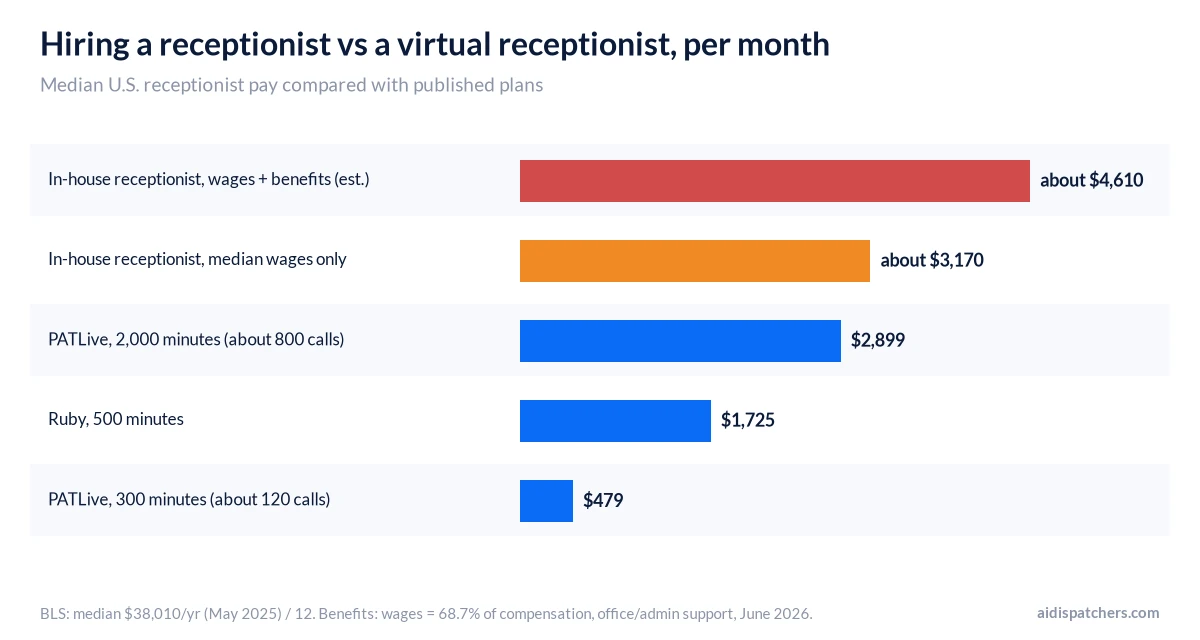
To put the wage figure in minutes: $3,170 a month is more than PATLive’s 2,000-minute plan ($2,899), which PATLive pegs at about 800 calls. Ruby’s 500-minute plan is $1,725. Unless your phone rings almost nonstop, the virtual service costs less.
How does AI receptionist pricing compare?
An AI receptionist is software, not a person, and it costs far less per call. We priced the same 300-minute, 120-call month on published AI plans:
| AI service | Billing | Cost for about 120 calls / 300 minutes |
|---|---|---|
| Goodcall | Unique customers | $79 (Starter: 100 unique customers, which Goodcall puts at about 150 calls) |
| Dialzara | Minutes | $135 ($99 for 220 minutes + 80 at $0.45) |
| Rosie | Minutes | $149 (Scale, 1,000 minutes, includes calendar booking) |
| Smith.ai AI Receptionist | Per call | $262.50 ($150 for 75 calls + 45 at $2.50) |
| AI Dispatchers | Minutes | $499 (Growth, up to 300 minutes) |
That’s us at the bottom, and we’re not going to dress it up. Our Growth plan costs more than every other AI plan in this table at this volume, and a little more than PATLive’s 300 human minutes ($479). Starter is $299 for the first 100 minutes, which is $2.99 a minute. Our site doesn’t publish an overage rate, so ask us before you plan on going past your minutes.
Here’s what you get for it. Booking and text confirmations come on every plan. The $499 tier is the one with emergency and priority escalation, which matters if a 2 a.m. call can be a burst pipe, plus smart routing and transfers, two-way texting and a live dashboard. We don’t bill per call. Setup is included too: we configure the AI with your services, pricing, hours and scheduling rules. For a shop where one booked job covers the month, that’s a fair trade. If you mostly need messages taken, buy one of the cheaper plans above.
Abby mixes the two. You can split calls between people and AI on one plan, and an AI minute counts as half an Abby Minute, so a plan can stretch up to twice as far. For more on the AI side, see our guide to the best AI receptionist and AI receptionist vs answering service vs voicemail.
Which virtual receptionist pricing model fits your business?
Pull up last month’s call log. Count the calls, then find the average length. Calls times length gives you minutes; pad that a bit if the company rounds up.
Short, frequent calls favor a company that bills to the second or doesn’t charge for after-call work. Long calls, like legal intake or a homeowner describing a leak in detail, favor per-call billing. If you need someone to book appointments, check whether booking is included or billed per call. If volume swings with the seasons, as it can for HVAC and other home services, look hard at the overage rate, because that’s what your busy month is billed at.
Use a free trial to measure real minutes. PATLive gives you 14 days, Posh 7 days or 250 minutes, and Abby has one on every plan. Still not sure you need a service? Work out what a missed call costs you first. Our answering service cost guide covers the call-center services that don’t sell themselves as receptionists, and if nights and weekends are your gap, see after hours answering service options.
Want a second opinion? Send your call count and average call length through the form at the bottom of this page, and we’ll tell you which plan fits, ours or not.
Prices last checked October 19, 2026, on each company’s own pricing page. They change, so confirm before you buy.
Questions people ask about virtual receptionist cost
How much does a virtual receptionist cost per month?
On the published plans we checked on October 19, 2026, live virtual receptionists start at $49 to $65 a month on pay-as-you-go plans (PATLive and Posh), and 100 minutes costs $189 to $395. At 300 minutes, the bills we could work out ran from $395 at AnswerConnect to $1,125 at Smith.ai, assuming 2.5-minute calls. Your average call length matters as much as the plan, so time a week of calls before you compare.
How much does Ruby receptionist cost?
Ruby’s pricing page lists $250 a month for 50 receptionist minutes, $395 for 100, $720 for 200 and $1,725 for 500, with no setup, onboarding or activation fees. Calls are billed in 60-second increments, rounded up, and the clock includes hold time and the time spent writing up your message. The overage rate isn’t on the page, so ask for it before you pick a plan.
Is a virtual receptionist AI?
Usually not. The term normally means a live person working remotely, and PATLive, for one, says it doesn’t use AI to answer calls at all. Some companies now mix AI in: Ruby offers optional AI enhancements on its plans, and Abby can send calls to AI answering, which uses half as many plan minutes. If it matters to you, ask who or what answers each kind of call.
Is a virtual receptionist cheaper than hiring a receptionist?
For answering phones, yes. BLS puts the median receptionist at $38,010 a year, about $3,170 a month before benefits, while Ruby’s 500-minute plan is $1,725 and PATLive’s 300-minute plan is $479. A hire makes more sense when the job includes front-desk work, like greeting visitors, that no phone service can do.
Is per-minute or per-call pricing better for a virtual receptionist?
Per-minute usually wins on short calls and per-call on long ones. At $1.99 a minute (PATLive’s overage on its 200-minute plan), a 2-minute call costs $3.98 and a 9-minute call $17.91. Smith.ai charges $8.50 to $11.50 per call over its plan, whatever the length, so the crossover is roughly 4 to 6 minutes. Divide last month’s minutes by your call count to see where you land.
What is the cheapest virtual receptionist?
It depends on your minutes. For a few calls a month, PATLive’s $49 pay-as-you-go plan was the cheapest of the seven live services we checked. At 100 minutes its $189 plan wins; at 300, AnswerConnect’s $395 Growth plan does. AI plans cost less again if you don’t need a person, starting at $79 a month for Goodcall’s Starter at about 120 calls.
How much does an AI receptionist cost?
Published AI plans we checked start at $29 a month (Dialzara, 60 minutes) and $49 (Rosie, 250 minutes), and Smith.ai has a free AI tier with 25 calls a month. For about 120 calls a month, the plans in this guide ranged from $79 at Goodcall to $499 for AI Dispatchers Growth. Look at which tier booking and live transfers start on, because that’s often where the price jumps.
Do virtual receptionists charge for spam or wrong-number calls?
Depends on the company. Smith.ai says spam and sales calls don’t count toward your quota as long as your forwarded lines pass caller ID. AnswerConnect waives the first 30 interactions under 30 seconds each billing cycle. Where every call rounds up to a full minute, a 10-second robocall costs a full minute, so ask how calls get filtered (Ruby lists robocall filtering as a feature).
Talk to us about your calls
Tell us a little about your business and a specialist will get back to you. Fields marked * are required.