
Ruby Receptionist reviews tend to split into two camps. People who like Ruby talk about warm, polished receptionists who sound like they work in your office. People who leave talk about the bill. Both camps are describing the same service: a live, U.S.-based receptionist team that charges by the minute, at rates well above most rivals.
Below you’ll find Ruby’s published prices as of November 7, 2026, plus the overage rates Ruby lists in its help center. We also go through how Ruby counts a “receptionist minute,” what reviewers say on Trustpilot, G2 and Capterra, and what the same month of calls would cost at Smith.ai, Posh, PATLive and with our own AI plans.
Prices come from each company’s own site, checked November 7, 2026 (America/Chicago). Review quotes are short and linked to the page they came from. Nothing here is from a paid relationship with Ruby.
The short version
Ruby makes sense when every caller should reach a trained human and you get maybe 30 to 80 calls a month. You also need to care more about how the call sounds than what it costs. It’s a poor fit if your calls run long, you get a lot of spam or hang-ups, or you’re watching every dollar. On a typical 100-call month, Ruby comes out around $720. PATLive’s published plans put the same minutes at $349.
Ruby says as much itself. A help-center article from July 31, 2026 opens with: “We know we’re not the least expensive receptionist service option out there.”
What Ruby actually sells
Ruby (the company is Ruby Receptionists, Inc.) sells three things: live phone answering, managed website chat, and a bundle of the two. All phone answering is done by people. Ruby’s homepage FAQ says so directly: “Ruby uses live, human receptionists.” The AI is behind the scenes, in call transcripts, sentiment tags, robocall screening and what Ruby calls AI-assisted call flows. The person your caller talks to is still a receptionist. Lots of people search for it as the Ruby answering service, and that’s fair, though Ruby calls itself a virtual receptionist because its staff do more than take messages.
Receptionists answer in your business name and transfer or take messages. Depending on your setup they’ll also answer common questions, book appointments, take payments, run intake and make outbound calls. Ruby serves the United States, Canada and the U.S. Caribbean, and says it has been at this for more than 20 years. Its customers lean toward law firms, home services, clinics, real estate and other small offices.
Ruby Receptionist pricing (checked Nov 7, 2026)
Ruby’s public plans and pricing page shows four phone plans. For the rest you have to dig. The help-center article “Am I on the right billing plan?” (dated December 11, 2025) adds the overage rate for each plan and several sizes the public page leaves off.
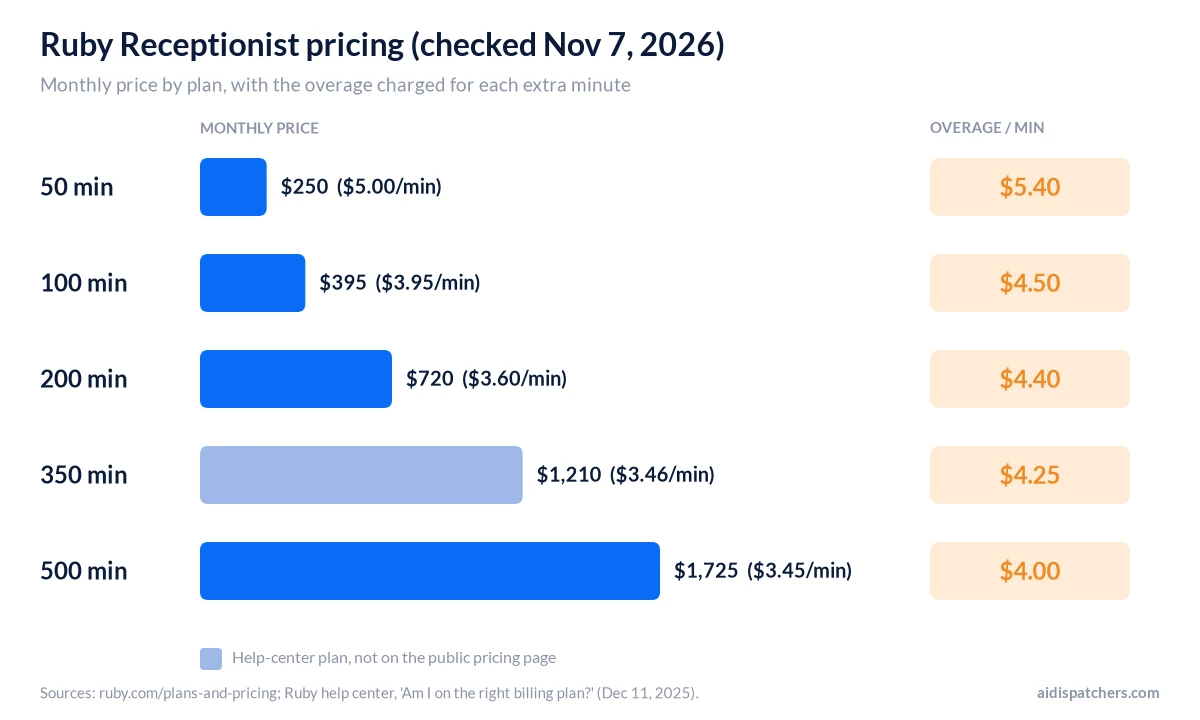
| Plan | Monthly price | Minutes included | Works out to | Overage per minute |
|---|---|---|---|---|
| Call Ruby 50 | $250 | 50 | $5.00/min | $5.40 |
| Call Ruby 100 | $395 | 100 | $3.95/min | $4.50 |
| Call Ruby 200 | $720 | 200 | $3.60/min | $4.40 |
| Call Ruby 350* | $1,210 | 350 | $3.46/min | $4.25 |
| Call Ruby 500 | $1,725 | 500 | $3.45/min | $4.00 |
| Call Ruby 750* | $2,550 | 750 | $3.40/min | $3.85 |
| Call Ruby 1,000* | $3,350 | 1,000 | $3.35/min | $3.65 |
*Listed in the help center but not on the public pricing page today. The help-center table runs up to 2,500 minutes for $7,875 ($3.30 overage). Ruby says to call sales for bigger plans.
The overage rate is higher than the plan’s own per-minute rate on every tier. Go 40 minutes over on the 100-minute plan and that’s $180 on top of the $395. Ruby won’t bump you to a bigger plan by itself. The overage shows up on next month’s invoice, and the app pings you at 85% and again at 100% of your minutes.
Chat is priced separately: 10 chats for $143, 30 for $335 and 50 for $520 a month. Add chat to a phone plan and Ruby takes 20% off the chat portion (10 chats for $114.40, 30 for $268, 50 for $416).
How a Ruby receptionist minute is counted
The price card is only half the bill. The other half is how Ruby defines a minute, and that’s spelled out in its FAQ and its billing basics article.
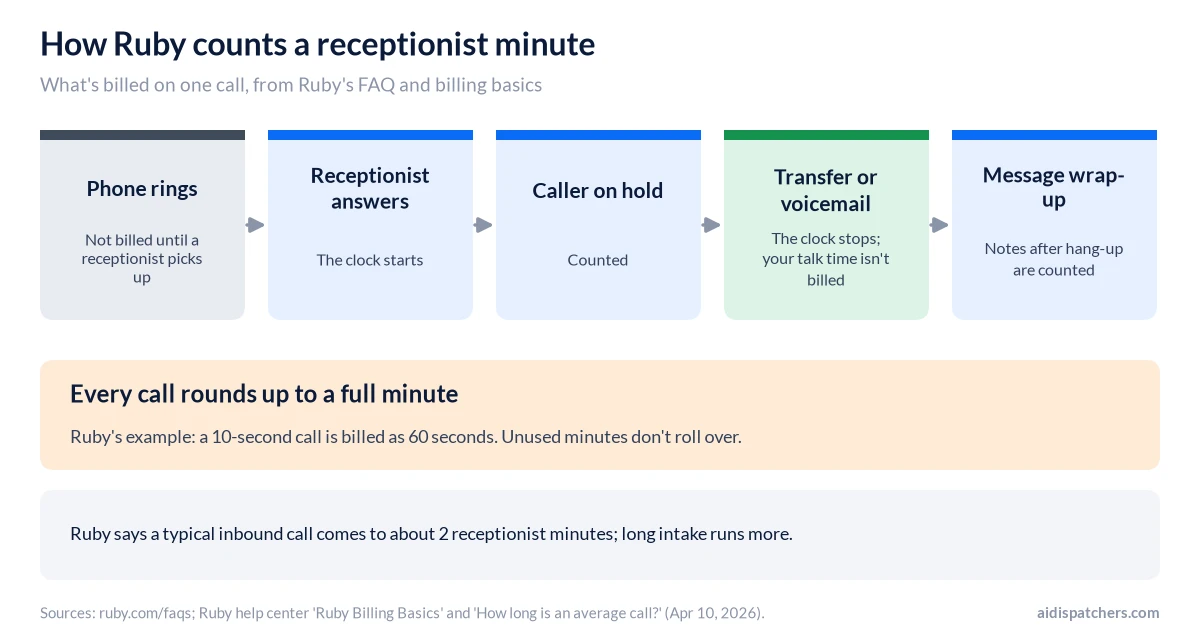
- Rounded up per call. Calls bill in 60-second steps. Ruby’s own example: a 10-second call bills as 60 seconds.
- Hold time counts. Billing begins when a receptionist answers, and minutes a caller sits on hold are part of it.
- After-call work counts. Time spent finishing the message after the caller hangs up is billed too.
- Your talk time doesn’t. Ruby stops counting when it hands the call to you or to your voicemail.
- Unused minutes vanish. They don’t roll over to next month.
How long is a call? Ruby’s help center says a typical inbound call “results in around 2 receptionist minutes,” and that intake forms or chatty callers run longer. That two-minute figure drives the math below. If you take detailed intake, plan on more.
Two practical tricks come straight from Ruby’s own cost-cutting article. Set your phone to ring in the office twice before rolling to Ruby, so you only pay for the calls you miss. And send after-hours calls to voicemail if they don’t need a person, since Ruby says calls that go to after-hours voicemail aren’t billed.
What a month of calls costs at Ruby vs. others
Here’s the same three months priced five ways, using Ruby’s two-minute average: 40 calls (about 80 minutes), 100 calls (about 200 minutes) and 150 calls (about 300 minutes). For each company we picked the cheapest published plan for that usage, overage included. Smith.ai’s live receptionists bill per call, so they’re priced by call count.
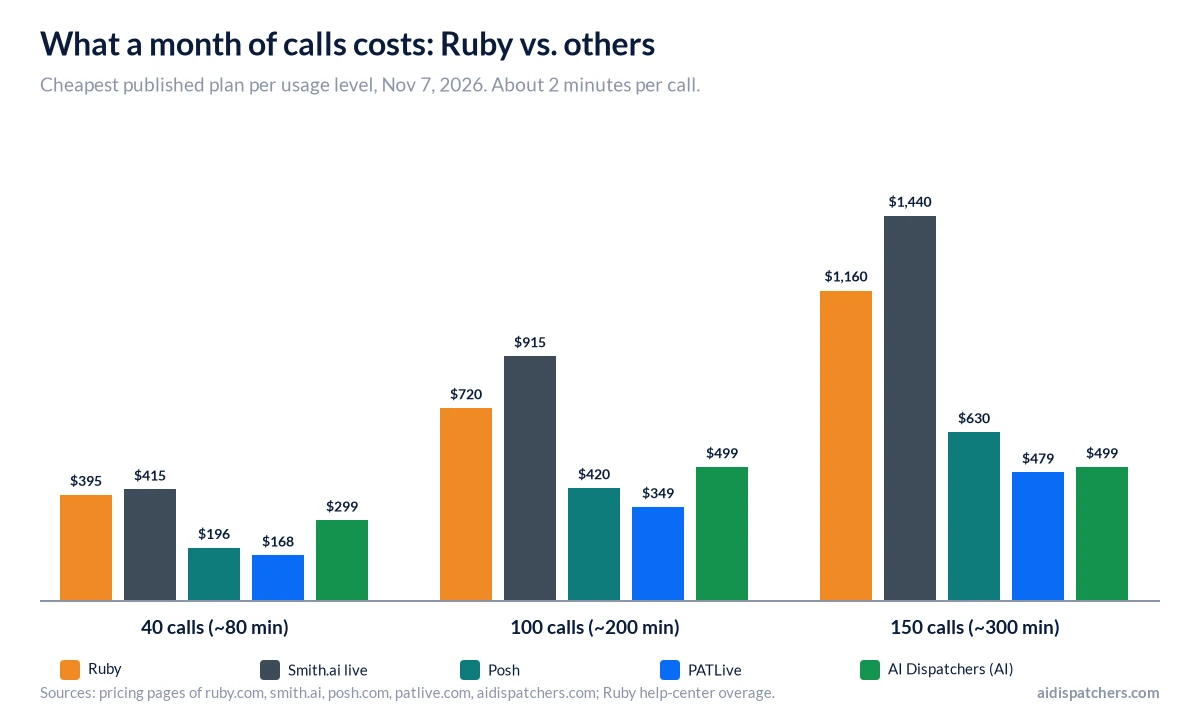
| Service | Answered by | 40 calls (~80 min) | 100 calls (~200 min) | 150 calls (~300 min) |
|---|---|---|---|---|
| Ruby | People | $395 (100-min plan) | $720 (200-min plan) | $1,160 (200 min + 100 × $4.40) |
| Smith.ai receptionists | People | $415 ($300 for 30 + 10 × $11.50) | $915 ($810 for 90 + 10 × $10.50) | $1,440 ($810 + 60 × $10.50) |
| Posh | People | $196 (50 min + 30 × $2.20) | $420 (200-min plan) | $630 (200 min + 100 × $2.10) |
| PATLive | People | $167.70 (50 min + 30 × $2.29) | $349 (200-min plan) | $479 (300-min plan) |
| AI Dispatchers | AI voice agent | $299 (Starter, 100 min) | $499 (Growth, 300 min) | $499 (Growth, 300 min) |
A few caveats. Every company counts minutes its own way, so the same calls won’t always produce the same minute total. Taxes and add-ons aren’t in these numbers. Also, an AI agent and a person aren’t the same product. That’s the point of putting them side by side. You’re picking the kind of answer your callers get, and the price comes with it.
Something odd shows up at 150 calls. Ruby’s 350-minute plan is $1,210, but staying on the 200-minute plan and eating 100 minutes of overage costs $1,160. We checked Ruby’s own plan table and it agrees: the 350 plan only starts winning at about 312 minutes. Close to that line? Ask Ruby which plan to start on. Downgrades take months (see the fine print below).
Want the wider picture? Our virtual receptionist cost guide compares seven services. The per-call model gets its own breakdown in our Smith.ai reviews and pricing page.
Ruby Receptionist reviews: what public sources say
The scores depend a lot on where you look. Trustpilot has by far the most reviews and the highest score. G2 and Capterra have only a dozen or so each, and they run lower.
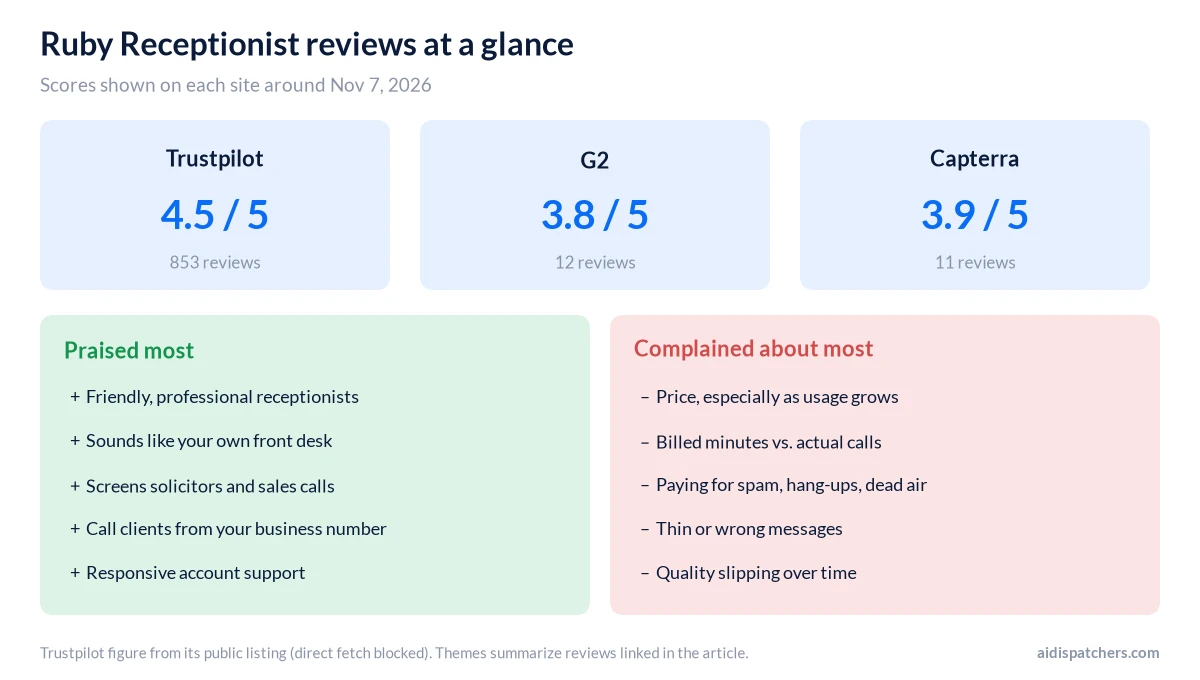
| Site | Score | Reviews | Notes |
|---|---|---|---|
| Trustpilot | 4.5 / 5 | 853 | 84% five-star, 4% one-star; about 30 reviews in the last 12 months (from the page’s search listing; Trustpilot blocked our direct fetch) |
| G2 | 3.8 / 5 | 12 | No reviews below three stars; most are from 2021 to 2023 |
| Capterra | 3.9 / 5 | 11 | Page last updated October 19, 2026; two one-star reviews |
What people praise
The receptionists get most of the credit. “It is like having an actual receptionist in your office,” an attorney wrote on Capterra in 2019. On G2, Ana G., an inside sales manager, said in December 2025 that receptionists “are trained to sound like they are internal employees.” Screening out solicitors comes up again and again, as does the app feature that lets you call clients from your business number on your cell. Support for account changes gets good marks too.
What people complain about
Price, first. Even happy reviewers mention it. A 2019 Capterra review is titled “Awesome, But A Little Too Expensive,” and a 2022 one warns that the service “can get very expensive the more it’s used.”
Billing is the sharper complaint. A G2 reviewer in 2021 said audits turned up gaps between calls made and time billed. Robert W. on Capterra (August 2023) said 15% of his calls were dead air and he was billed for them. A 2023 G2 reviewer said messages were billed at five minutes while the details were “scant or incorrect.” On Trustpilot, one recent reviewer says spam and hang-up calls jumped whenever the account was active. Those calls ate paid minutes. These are individual accounts, not proof of a pattern, but they line up with how per-minute billing works: every call that reaches a receptionist costs at least a minute.
Message quality and setup round it out. Several reviewers say quality slipped over time. A G2 reviewer from December 2025 said getting set up took two to three weeks of trial and error, though Ruby credited part of the bill for the delay. The advice on that G2 page is worth copying: give Ruby “very specific and detailed call flow instructions.”
Fine print to read before you sign
Ruby doesn’t hide any of this. You’d just have to read its terms, FAQ and help center to find it all.
- Month to month, auto-renewing. The terms of use say a subscription renews every 30 days unless you cancel or change it.
- Money-back window. First-time customers can cancel for a full refund within 21 days or before using 500 receptionist minutes, whichever comes first (per Ruby’s FAQ).
- Downgrades wait. After an initial three-cycle calibration period, you can upgrade any time, but a downgrade needs three straight billing periods on the same plan.
- The base fee is prepaid and non-refundable outside that guarantee, per the terms. Overage is billed after the month ends.
- Setup fees. The pricing page says there are no activation, onboarding or setup fees. The terms still mention setup or activation fees “as applicable,” so get the quote in writing.
- Spanish hours. The pricing page and homepage say bilingual answering is 24/7. Ruby’s FAQ page still says bilingual service runs Monday to Friday, 5 a.m. to 6 p.m. Pacific. Ask which is current if Spanish callers matter to you.
- Prices can change. The terms let Ruby change plans and pricing at any time.
When Ruby is the right call (and when it isn’t)
Pick Ruby if a polished human voice is part of how you sell. Think of a law firm where a missed new-client call is expensive, or a boutique business where the phone is your front desk. With 30 to 80 short calls a month, you’ll pay roughly $200 more than the cheapest live services. Plenty of owners are fine with that.
It gets expensive fast in three situations. Long calls, like intake forms or troubleshooting. Lots of spam and wrong numbers. And volume that swings from month to month, because overage is pricey and downgrades are slow. For live answering at lower per-minute rates, Posh and PATLive are the obvious comparisons. If your callers mostly need to book a job, get a quote or leave details, an AI receptionist may handle it for less. Our AI vs. human receptionist comparison walks through which calls each handles well.
Five things to do in your first 21 days
The money-back window is short, so use it as a test period.
- Place five test calls yourself: a new customer, an existing one, a wrong number, a caller who wants a price, and one who refuses to give details. Read the messages that come back.
- Check the minute log daily. Compare billed minutes against your phone records for a handful of calls. If the gap surprises you, ask Ruby to explain it before day 21.
- Set delayed forwarding so your office gets the first two rings.
- Write tight call flows. Every extra intake question adds receptionist time you pay for.
- Look at your spam share. If robocalls and hang-ups are eating minutes, ask what Ruby’s filtering will catch, and decide before the window closes.
Where AI Dispatchers fits
We sell an AI voice agent, not live receptionists, so we’re a different kind of alternative to Ruby. Our published plans are $299 a month for the first 100 minutes and $499 for up to 300 minutes. That’s less than Ruby at every volume in the table above. PATLive’s live plans cost less at all three, though, and Posh is cheaper until you get near 300 minutes. Some callers also just want a person. If yours do, Ruby or another live service is the better choice.
A lot of small-business calls are someone wanting to book a job, get a rough price or leave a message at 9 p.m. Those are the calls our agent was built for. Book a demo and listen to it handle a few of yours, or ask us something with the form below. For more on overnight coverage, see our after-hours answering service guide.
Ruby Receptionist reviews FAQ
How much does Ruby Receptionist cost?
Ruby’s public pricing page lists $250 a month for 50 receptionist minutes, $395 for 100, $720 for 200 and $1,725 for 500 (checked November 7, 2026). Its help center shows overage from $5.40 a minute on the smallest plan down to $4.00 on the 500-minute plan. At Ruby’s own estimate of about two minutes per call, 100 calls a month lands around $720.
Is Ruby Receptionist AI?
No. Ruby’s site says its calls are answered by live, human receptionists. It uses AI behind the scenes for transcripts, sentiment tags, robocall screening and call-flow prompts, but an AI does not pick up and run the call.
Is Ruby Receptionist legit?
Yes. Ruby Receptionists, Inc. is a real company, and it says it has been doing this for more than 20 years. Its Trustpilot page showed 4.5 out of 5 from 853 reviews in early November 2026. Smaller samples on G2 (3.8 from 12) and Capterra (3.9 from 11) are less glowing, mostly over price and billing.
Does Ruby Receptionist offer a free trial?
Not a free trial in the usual sense. Ruby offers first-time customers a money-back guarantee: cancel within 21 days, or before using 500 receptionist minutes, whichever comes first, and you get a full refund for that service. Use that window to test calls and check your minute log.
Do unused Ruby minutes roll over?
No. Ruby’s billing help article says unused receptionist minutes and chats don’t carry into the next month. If you go over, extra minutes bill at your plan’s overage rate on the following invoice, and Ruby won’t move you to a bigger plan unless you ask.
Are Ruby’s receptionists bilingual?
Ruby offers English and Spanish call handling. Its pricing page and homepage describe bilingual answering as available 24/7, while an older FAQ entry lists weekday hours of 5 a.m. to 6 p.m. Pacific. If Spanish callers are a big part of your business, confirm the current hours with sales.
What are the best Ruby Receptionist alternatives?
If you still want people on the phone, Posh and PATLive charge less per minute. On November 7, 2026, 200 minutes cost $420 at Posh and $349 at PATLive. Ruby charged $720. Smith.ai bills live calls per call instead. If an AI voice agent suits your calls, AI Dispatchers starts at $299 for 100 minutes.
Talk to us about your calls
Tell us a little about your business and a specialist will get back to you. Fields marked * are required.