
Slang AI is a voice AI phone host built only for restaurants. It answers calls, books tables in OpenTable, SevenRooms, Resy and Yelp, texts guests links, and hands VIPs and tricky calls to your staff. On its pricing page, plans start at $399 per location for Core and $599 for Premium, with Enterprise quoted separately. Slang’s own comparison pages describe those as monthly prices.
That’s the headline. The details that change what you’ll actually pay sit in Slang’s terms of service: a usage-based “Price Tier,” fees billed a month in advance, a 30-day pilot window, and contracts that renew on their own. This review walks through the plans, the contract, what reviewers say, and how Slang compares on cost with Yelp Host and with general AI receptionists, ours included. We sell an AI voice agent too, so weigh our view with that in mind. For a busy full-service restaurant, Slang is the better fit than we are, and we explain why below.
Everything about Slang here comes from slang.ai (pricing page, terms of service, product, integration and comparison pages) and its G2 listing, all checked on Nov 17, 2026 (Central time). Competitor prices were checked the same day. Slang didn’t review this article, and nobody paid us for it.
The short version
Got a full-service dining room, or a group of them, with a reservation book that fills up? Slang is about as complete as this niche gets, and the booking integrations are why.
It isn’t cheap: $4,788 a year for one location on Core. Three locations? $1,197 a month.
And it won’t take a food order over the phone. Per Slang’s phone-answering page, it points callers to online ordering or passes them to staff. A pizza place living on phone orders should stop here and think.
Get the order form before signing. Two lines on it matter most: your usage limit and how long the first term runs.
Slang AI pricing in 2026 (last checked Nov 17)
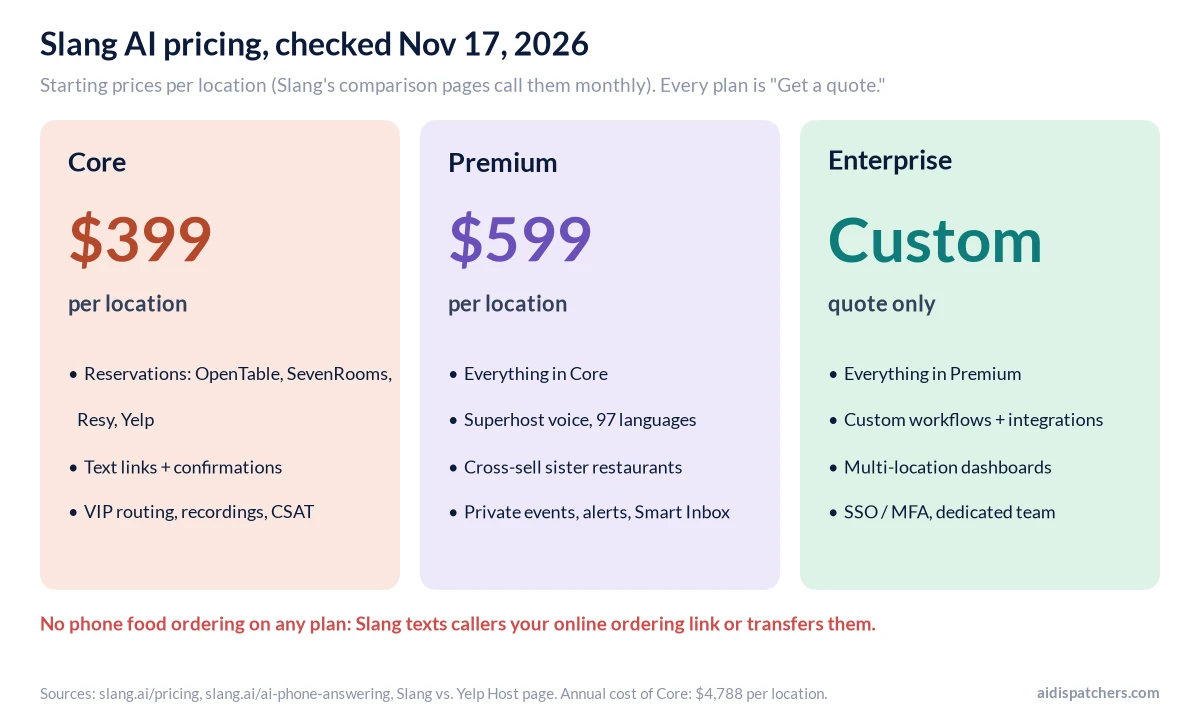
Slang lists three plans. Every plan button says “Get a quote,” so the listed numbers are floors, not checkout prices.
| Plan | Listed price | What it adds |
|---|---|---|
| Core | From $399 per location | Reservation booking and changes, text links and confirmations, reservation integrations, VIP call handling, special-request capture, caller satisfaction scores, call recordings and summaries. The US version of the page also lists bilingual (Spanish) support. |
| Premium | From $599 per location | Everything in Core, plus the new “Superhost” voice: interruptible conversation, 97 languages, 20 premium voices, quality review of every call, cross-selling tables at sister restaurants, private-event lead capture, real-time alerts and a Smart Inbox. |
| Enterprise | Custom | Custom workflows and integrations, multi-location dashboards, SSO and MFA, and a dedicated team. |
Private-event capture through Tripleseat and Perfect Venue is also sold as an a-la-carte product. The page shows the same numbers in Canadian and Australian dollars ($399 CAD, AUD $399), so check which currency your quote is in.
Is Premium worth $200 more?
Premium costs $2,400 a year more per location than Core. It earns that if you get lots of non-English callers, run several restaurants that can share bookings, or book private events by phone. A single-location bistro whose callers mostly want a table for four on Friday probably doesn’t need it.
Is there an annual discount?
Slang’s pricing page doesn’t show one. Some third-party reviews quote lower annual rates, but we couldn’t find them on slang.ai, so ask your rep and get it on the order form.
What the terms of service say about cost
Slang’s contract is with Gablex Inc. (doing business as Slang.ai). It’s a business agreement built around order forms, and most of the money questions are answered there rather than on the pricing page.
The Price Tier rule
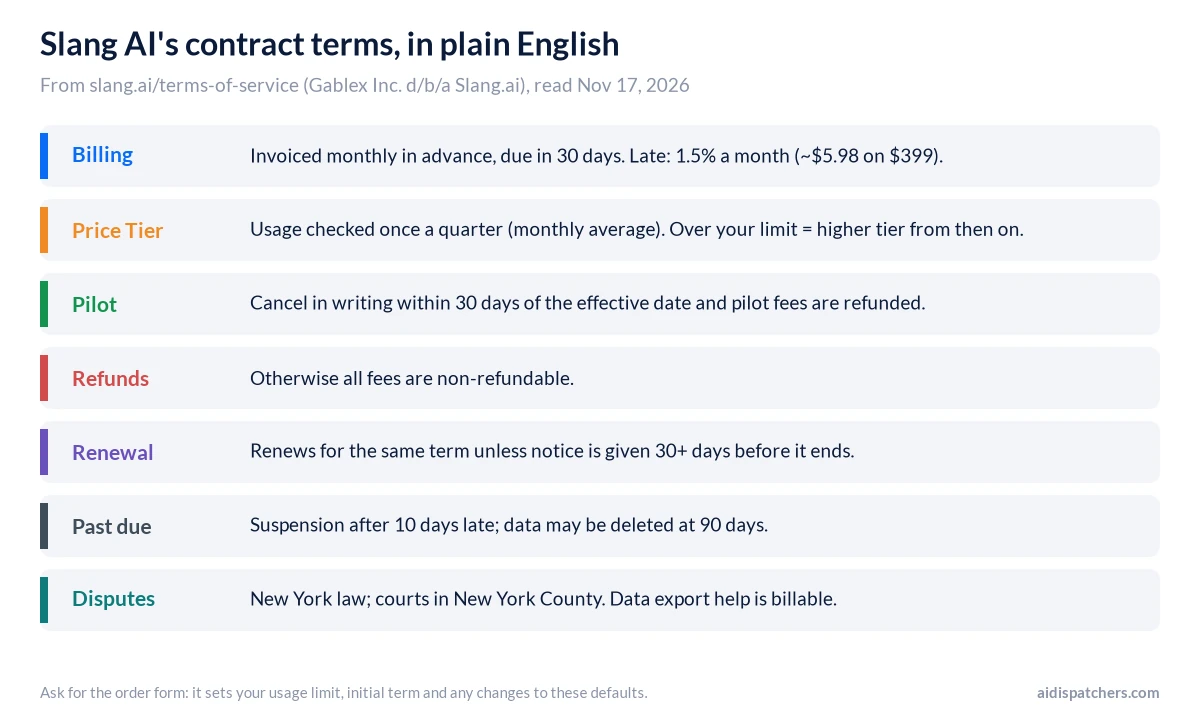
Your fee is tied to a Price Tier that “corresponds with Customer’s anticipated usage.” Slang checks your usage once per calendar quarter, on an average-calendar-month basis. If you’ve gone over the limit on your order form, every later invoice moves to the higher tier. A slow February won’t hurt you, but a summer patio season that lifts your monthly average could.
Why it matters: one Slang comparison page says there are “no per-call overage fees” and that “you never pay extra based on call volume,” while another says pricing is “customized based on call volume.” Both can be true at once. There’s no per-call charge, but a higher volume can put you on a higher tier. Ask what the limit is, in calls or minutes, before you sign.
Billing, late fees and refunds
- Billed in advance. Unless your order form says otherwise, fees are invoiced monthly in advance and due within 30 days, in US dollars.
- Late interest. Overdue invoices carry interest of 1.5% a month (or the legal maximum, if lower). On a $399 invoice that’s about $5.98 a month.
- Suspension and data. Slang can suspend service once an account is more than 10 days past due, and data may be deleted for good at 90 days delinquent.
- Refunds. Fees are non-refundable, with one exception: the pilot.
The 30-day pilot and automatic renewal
You can end the agreement with written notice within 30 days of its effective date, and Slang will refund fees you paid for the pilot. There’s no self-serve free trial on the site. The “Try Slang AI,” “Book a Demo” and “Get a quote” buttons all lead to the same demo request page. Mark day 25 on the calendar so the decision doesn’t slip past you.
After that, each order form runs for the initial term written on it and then renews for the same length unless either side gives notice at least 30 days before the term ends. If you sign for a year, a missed reminder means another year. Help exporting your data after you leave is billed at Slang’s standard rates, and disputes go to the courts of New York County under New York law.
Where Slang’s pages don’t quite agree
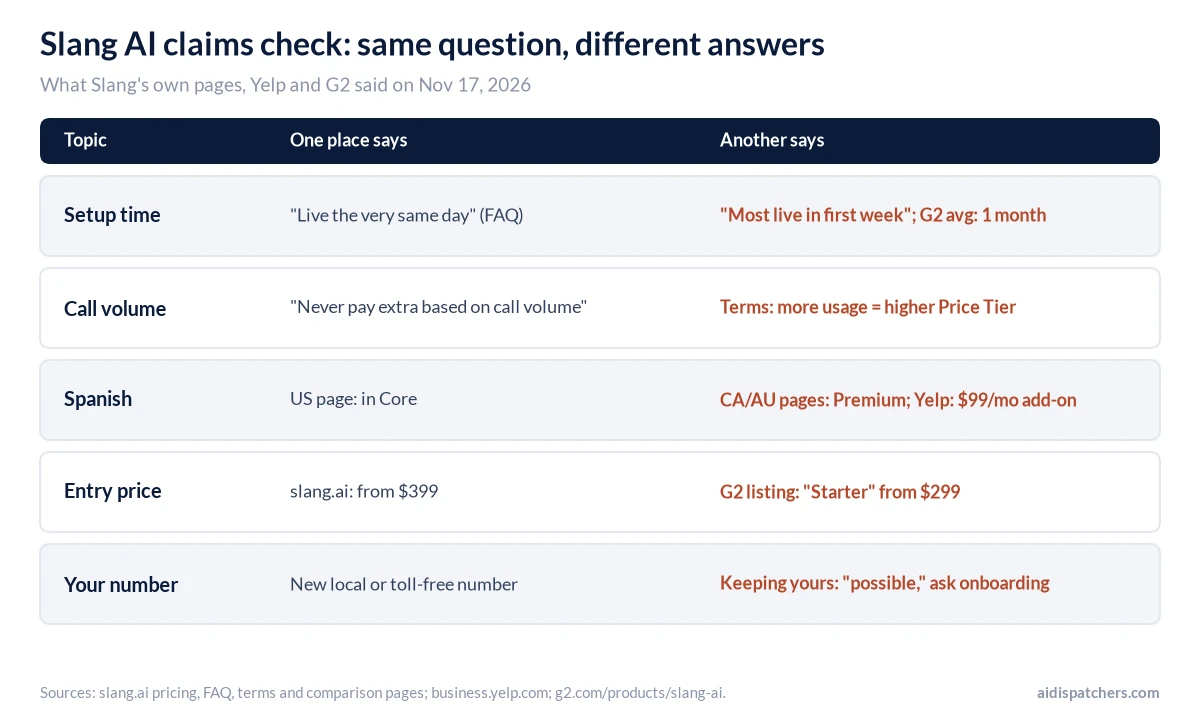
Small stuff, mostly. Still, bring each one to the sales call.
| Topic | One page says | Another says |
|---|---|---|
| Setup time | Pricing FAQ: less than 30 minutes of your time, live “the very same day” | Pricing comparison table: “most operators live in first week.” G2 reviewers’ average implementation time: 1 month |
| Volume and price | “You never pay extra based on call volume” (Slang vs. Yelp Host page) | Terms: higher usage moves you to a higher Price Tier |
| Spanish | US pricing page lists Bilingual Support in Core | Canadian and Australian versions list it under Premium; Yelp’s comparison says Slang charges $99 a month for Spanish on Core |
| Entry price | slang.ai: from $399 per location | Slang’s G2 listing still shows a “Starter” plan from $299 per location per month |
| Phone number | FAQ: Slang gives you a new local or toll-free number | Same FAQ: keeping your existing number is “possible,” to be discussed with onboarding |
What Slang AI does well
Reservations are the core of it. Slang lists integrations with OpenTable, SevenRooms, Resy and Yelp, and its Resy page describes the full loop: the guest calls, the AI checks availability, and the booking lands in Resy with a voice and text confirmation. Its State of the Restaurant Phone report says 57% of restaurant calls are about reservations, so that’s the right thing to be good at.
The VIP routing is a small thing that regulars notice: their number gets recognized, and the call rings through to your staff instead of the bot. Premium’s cross-selling, which offers a table at a sister restaurant when the first choice is full, only matters for groups, but for them it’s a real revenue feature.
Slang also has a lot of restaurant data to tune against. It says it’s built on more than 35 million calls and serves over 2,000 full-service restaurants. Those are Slang’s numbers, not independently checked, and its homepage says “thousands of restaurant operators,” so treat them as a rough sense of scale.
Where it falls short
- No phone ordering. When someone wants takeout, Slang sends them to your online ordering link or to staff. Pizza shops and fast-casual spots that live on phone orders will want a tool that takes the order itself.
- Price for small places. A neighborhood café that gets 60 calls a month is paying $399 for a fraction of what the product can do. One G2 reviewer put it plainly: for smaller businesses or those with lower call volumes, “the monthly fee can seem somewhat steep.”
- Restaurants only. If you also run a catering company or a retail shop, you’ll need something else for those lines.
- Quote-first buying. You can’t see your real price, usage limit or contract length until you’ve talked to sales.
Slang AI reviews: what’s out there
For a company with a $36M Series B behind it, there isn’t much independent feedback. This is what turned up on Nov 17, 2026.
| Source | What it shows |
|---|---|
| G2 | 4.4 out of 5 from 57 reviews (68% five-star, 26% four-star, 5% three-star). Reviewers praise the natural voice and round-the-clock answering; the complaints are price for low-volume businesses and trouble with unusual questions. Read a few reviews too, since the score hides something: the most visible one talks about “content suggestions” and moving “between different modules,” which doesn’t sound like a restaurant phone product. |
| Capterra | No Slang AI reviews that we could find. |
| Scattered mentions. One restaurant owner in r/restaurant (March 2024) said Slang sends callers an online-ordering link, books through Resy, and that its analytics showed 353 calls in one month that came in at the same time and “would have otherwise gone unanswered.” | |
| Slang’s own case studies | Useful for scale, but they’re marketing. Red Rocks Café (two locations) reports a 97% answer rate and 60% of calls fully handled by the AI over 90 days. |
Is Slang AI worth $399 a month?
Start with Slang’s State of the Restaurant Phone report. Its average restaurant fields 1,220 calls a month; about 12% overlap with another call and about 14% come in after closing. Plug in the report’s $100-per-reservation example and Core covers its fee, in revenue, with four extra bookings a month.
Revenue isn’t profit, though. If you keep around 10 cents of every dollar after food, labor and rent (pick your own number), $399 takes about $3,990 in recovered sales, which is 40 of those $100 tables. For a busy dinner spot that misses a dozen calls on a Saturday, that’s very reachable. For a quiet lunch counter, it may not be.
A cheap way to check: look at your phone carrier’s missed-call log for two normal weeks before the demo. If you can’t count more than a handful of missed calls that were likely bookings, $399 is hard to justify.
Slang AI vs. Yelp Host and general AI receptionists
Most restaurant AI tools don’t publish prices. Loman’s pricing page asks you to request pricing, and Hostie’s lists its plans without any prices. Yelp Host does publish, so it’s the most useful comparison.
| Calls a month (1.5 min each) | Slang Core | Slang Premium | Yelp Host Basic | Yelp Host Plus | AI Dispatchers |
|---|---|---|---|---|---|
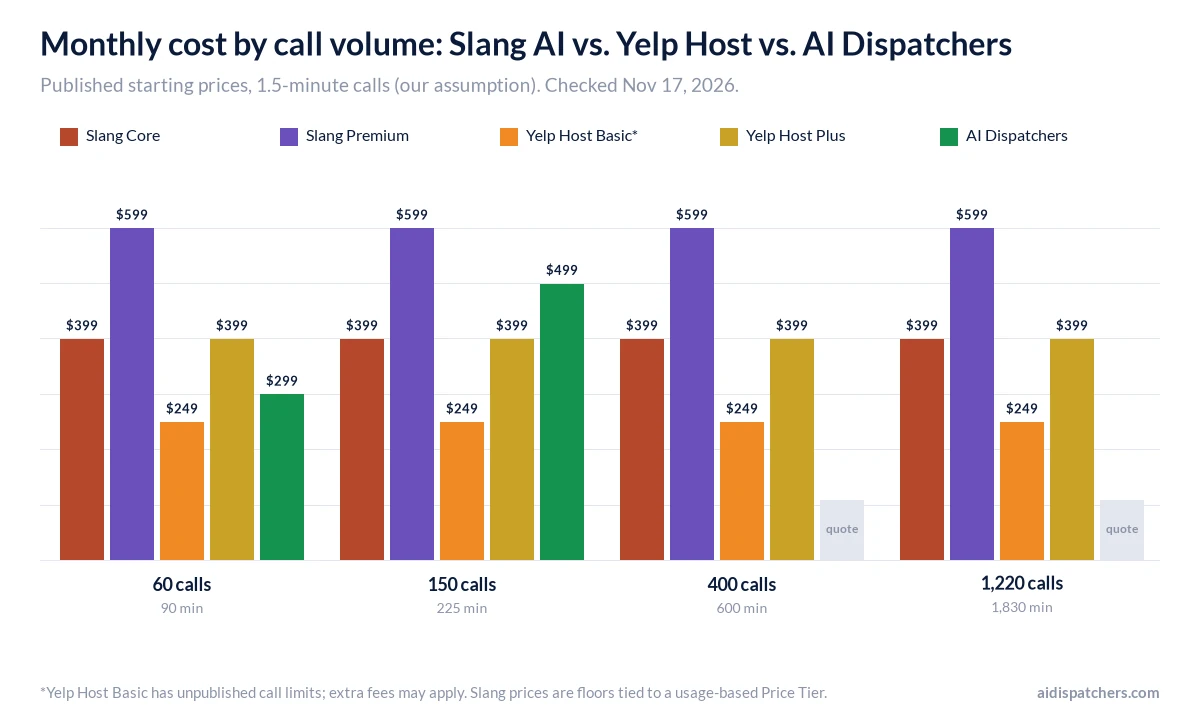
| 60 calls (90 min) | $399 | $599 | $249 | $399 | $299 (Starter) |
| 150 calls (225 min) | $399 | $599 | $249 | $399 | $499 (Growth) |
| 400 calls (600 min) | $399 | $599 | $249* | $399 | Custom quote |
| 1,220 calls (1,830 min) | $399 | $599 | $249* | $399 | Custom quote |
Slang prices are “starting at” figures, and your Price Tier depends on usage. *Yelp says Host Basic is “subject to call limits and additional fees may apply” without publishing the limit; Plus is $399 for unlimited calls. The 1.5-minute call length is our assumption for the math.
Yelp Host is the cheaper buy on paper. Yelp says it answers calls, handles reservations and waitlists, and takes takeout orders with no commission, which covers the ordering gap Slang leaves. It comes with a free period of up to 30 days. Slang’s advantages are its deeper reservation-platform integrations, VIP routing, private-event capture and tools for restaurant groups. If you’re on Yelp Guest Manager already, Yelp also offers discounted Host pricing.
General AI receptionists, like the ones in our best AI receptionist roundup or our Rosie AI pricing review, cost less at low volume but bill by minutes or calls. At 1,220 calls a month, a per-minute plan gets expensive fast, which is exactly where Slang’s per-location pricing makes sense.
Who Slang suits, and who should keep looking
Slang makes the most sense for full-service restaurants and groups that take a lot of reservation calls, use OpenTable, SevenRooms, Resy or Yelp, and want VIPs and event inquiries handled carefully. Multi-location groups get the most from Premium.
Keep looking if most of your calls are takeout orders, if you get fewer than a couple of hundred calls a month, or if you want to try a tool without a sales call and an order form. Yelp Host, or a general AI receptionist, may be a better match there. If after-hours calls are your main leak, our guide to after-hours answering services covers more options, and the real cost of missed calls helps you put a number on it.
Where AI Dispatchers fits
Straight answer: a busy dining room would blow past our published plans. We make one voice agent that works across lots of trades, restaurants included. Our pricing starts at $299 a month for the first 100 minutes, then $499 for up to 300. At a minute and a half per call that’s about 66 calls, or 200. Slang’s report says the average restaurant gets 1,220. For that kind of traffic, go with Slang or Yelp Host. We’d have to quote you a custom plan, and we’d rather tell you that now.
Where we can make sense is a small café, a catering kitchen or a hospitality business with lighter phone traffic that also wants bookings and SMS confirmations. At 60 calls a month our Starter plan costs less than Slang Core, though Yelp Host Basic is cheaper still. Setup and onboarding come with every plan, and there’s a 14-day free trial. If you need a particular reservation system connected, ask us to confirm it in writing before you switch. You can see what we do for restaurants and hospitality, book a demo, or send us a note with the form below.
Sources (last checked Nov 17, 2026): Slang AI’s pricing page, terms of service, AI phone answering page, integrations and Resy page, State of the Restaurant Phone report, comparison pages (Slang vs. Yelp Host, Slang vs. Loman AI) and the Red Rocks Café case study; Slang’s G2 listing; Yelp’s Yelp Host pricing page and Yelp Host vs. Slang article (read via search, as Yelp blocked our direct request); loman.ai/pricing; hostie.ai/pricing; Reddit r/restaurant (March 2024); aidispatchers.com pricing.
Frequently asked questions about Slang AI
How much does Slang AI cost?
Core starts at $399 a month per location and Premium at $599 (slang.ai pricing and comparison pages, Nov 17). Enterprise gets quoted. Treat those as floors. Your Price Tier depends on usage, so the order form can come in higher; ask for the limit in writing.
Is Slang AI legit?
Yes. You sign with Gablex Inc., which does business as Slang.ai. It has 57 reviews on G2 averaging 4.4, and restaurant groups like Red Rocks Café and Legal Sea Foods appear on its customer pages. The big numbers on its site are its own, though. Test it in the pilot on a Friday night, not just in a demo.
Does Slang AI integrate with Resy?
Slang lists Resy as a reservation integration, along with OpenTable, SevenRooms and Yelp. Its Resy page says guests can book, modify and cancel by phone, and the booking is sent to Resy with a voice and text confirmation. Ask which integrations your plan includes, since Slang’s terms say it can’t guarantee any third-party integration will continue.
Does Slang AI have a free trial?
Not a self-serve one. Instead, its terms give you a 30-day pilot period from the agreement’s effective date: end it in writing within that window and Slang refunds the fees you paid for the pilot. After that, fees are non-refundable.
Can Slang AI take takeout orders over the phone?
Not by itself. When a caller wants takeout, Slang points them to your online ordering (often by text) or hands them to staff. Heavy phone-order business? Look at Yelp Host or Loman, which take the order on the call.
Can I keep my restaurant’s phone number with Slang AI?
Slang’s FAQ says it gives you a new local or toll-free number to put on your website and Google Business Profile. Keeping your existing number is described as possible but something to discuss with its onboarding team. If your number is printed on menus and signage, settle this before you sign.
How long does Slang AI take to set up?
Slang says it needs less than 30 minutes of your time and can go live the same day, though another part of its pricing page says most operators are live in the first week. G2 reviewers report an average implementation time of about a month. Plan for a week of tuning answers before you trust it on a Saturday night.
Who are Slang AI’s main competitors?
The restaurant-specific names Slang compares itself with include Yelp Host, Loman AI, Hostie, PolyAI, Revmo and Sadie. Of those we checked, only Yelp Host publishes prices ($249 a month for Basic, $399 for Plus with unlimited calls). General AI receptionists cost less at low call volumes but usually bill by the minute or call.
Talk to us about your calls
Tell us a little about your business and a specialist will get back to you. Fields marked * are required.